The Forbidden City
The palace compound is a walled rectangle ringed by a moat, with its halls set along a strict north–south line. On the map it forms the solid, calm centre that every ring road circles.
Fakatino mape mukamuka · China
39.9075° N / 116.3972° E
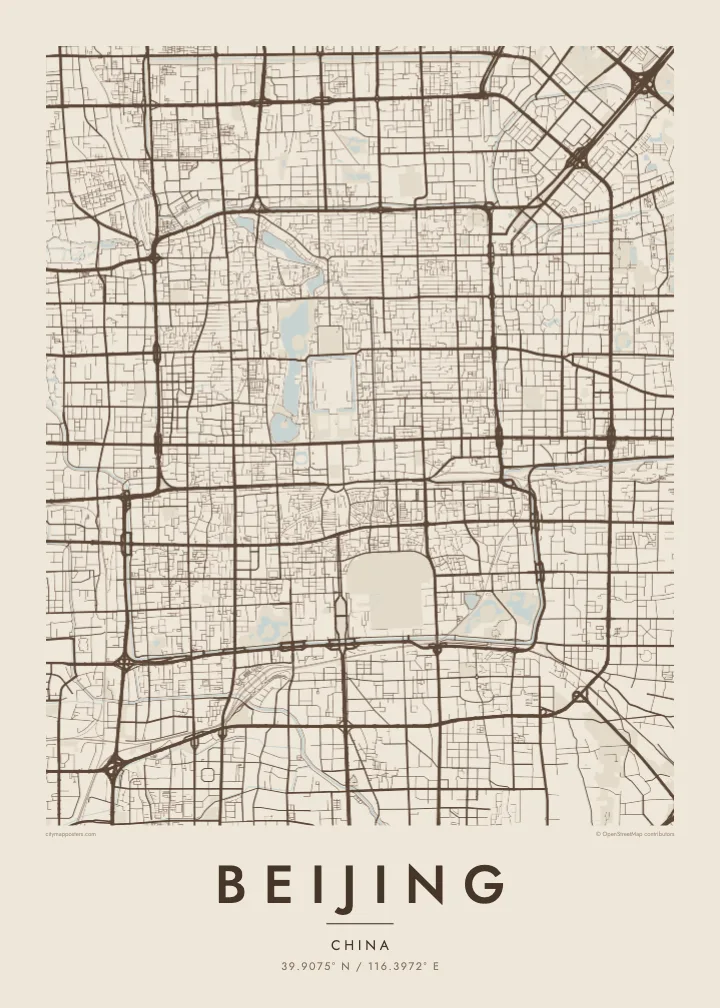
Concentric ring roads around a walled palace, cut through by a north–south axis that has ordered the city for centuries
Taha e taone, lima e onoonoaga
Tapaki e taha puhala ke kitia ai ki luga he puipui. Kua tatai e totogi he tau puhala oti — pete he lolomi, poloka, po ke faila HD.
 Tau pikselo mooli · faila lolomi 24 × 36″
Maama mitaki ke lolomi
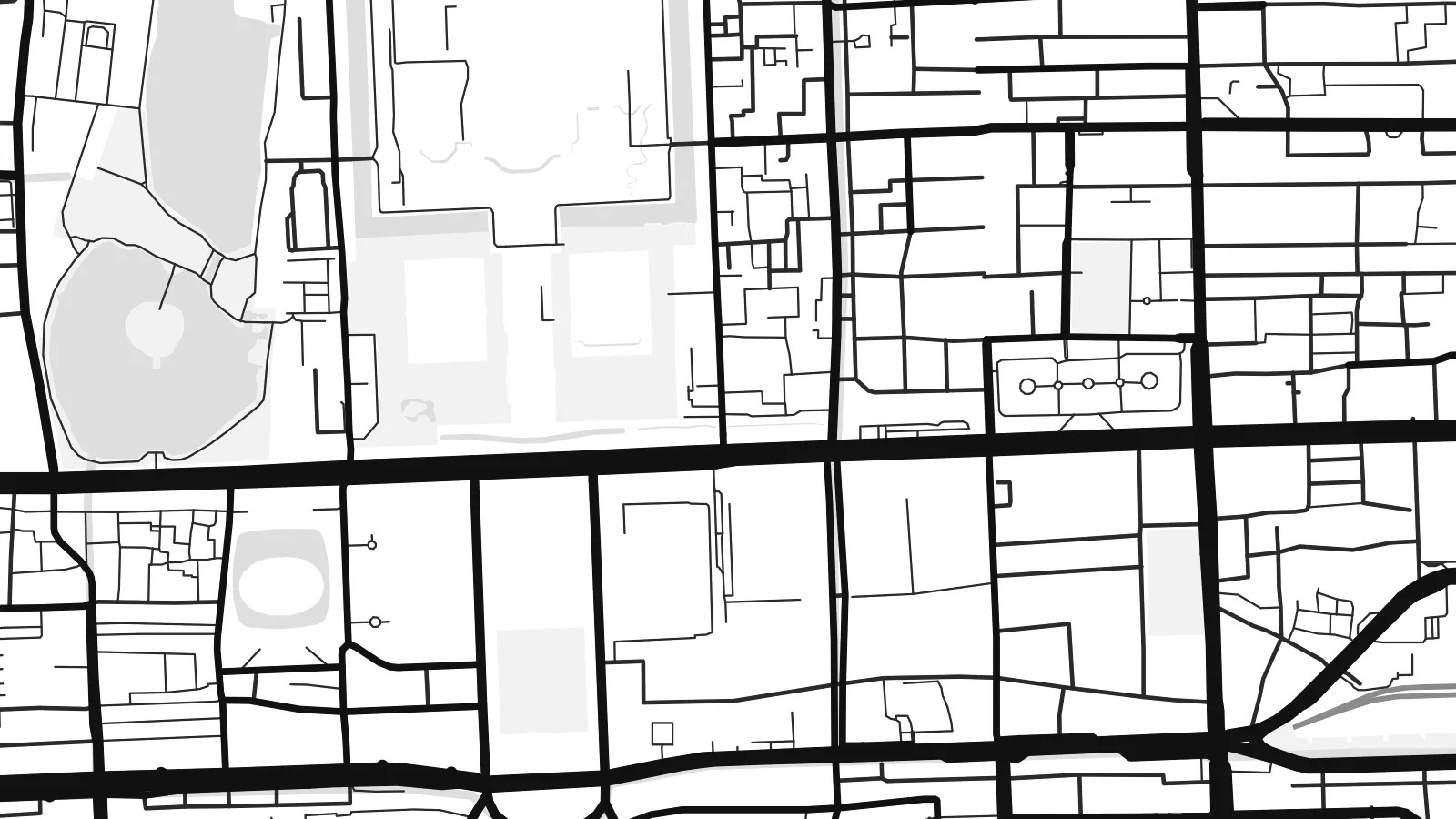
Ko e 100% e fahi mooli mai he faila lolomi. Ko e tau poster oti — pete kua lolomi, poloka, po ke utu hifo — kua taute ke he ha mautolu a tau tokoluga (server) ke he 300 DPI, hokotia ke he 7,200 × 10,800 piksela, ke maeke ai e tau ala ikiiki tote ke maaliali fakamitaki he lolomi 24 × 36″.
He Pā


Ko e mape
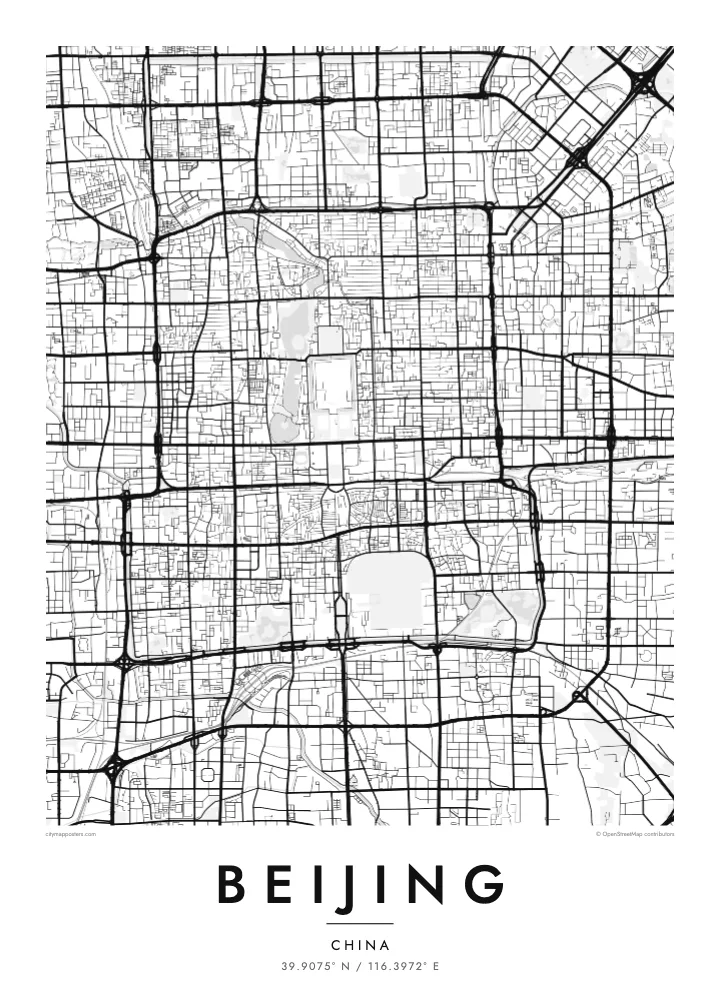
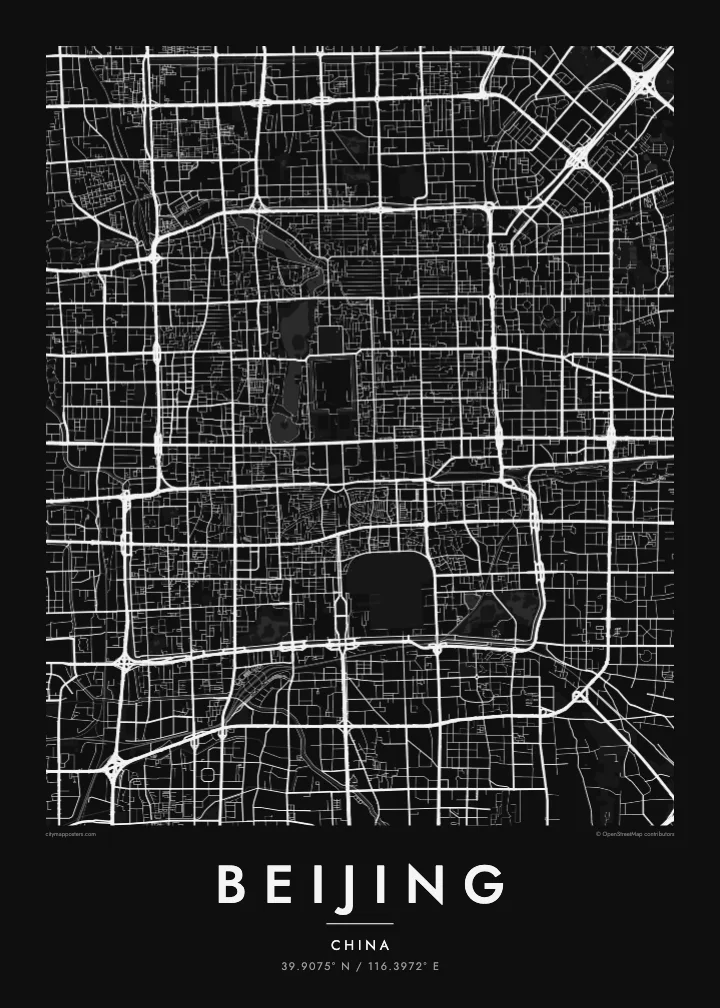
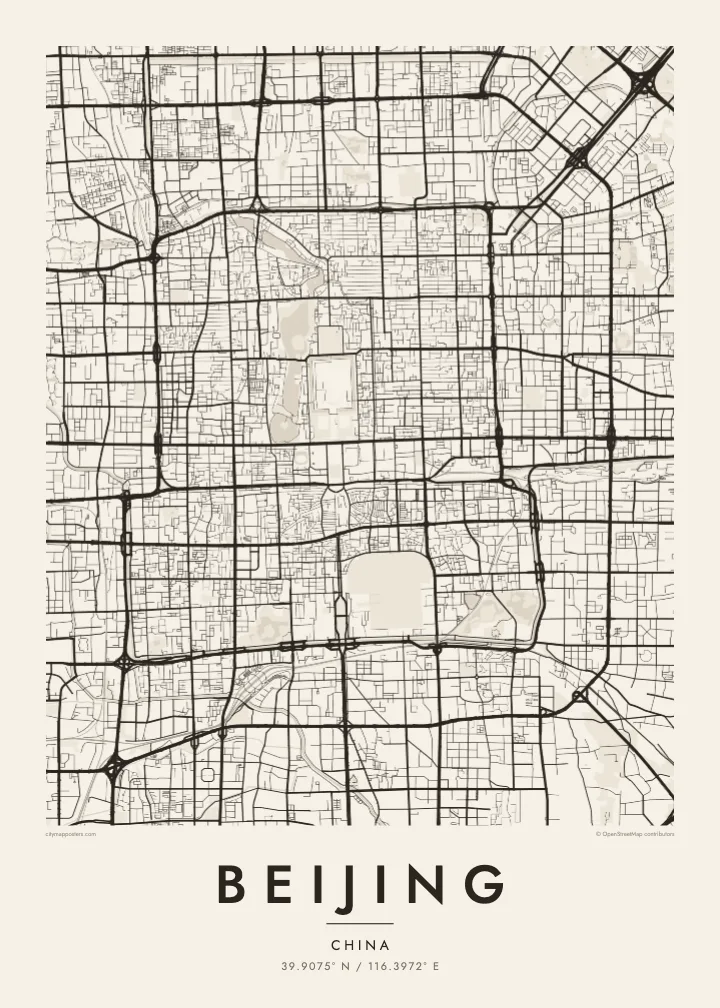
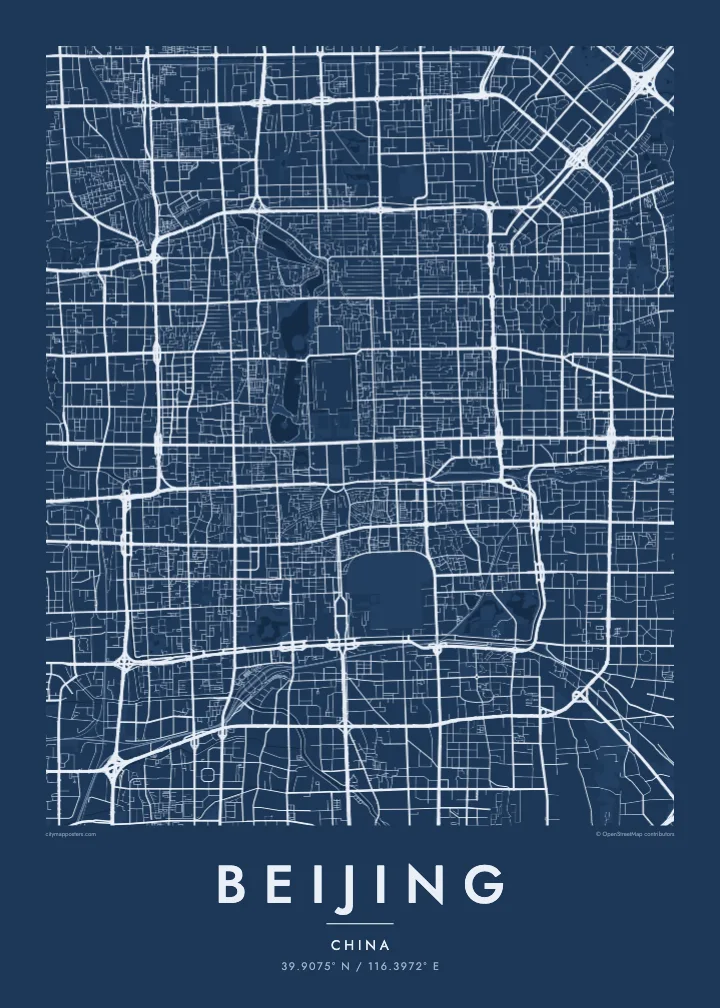
From above, Beijing reads like a set of nested frames. The Forbidden City sits at the centre, a precise rectangle surrounded by a moat, and around it the Second, Third, Fourth, Fifth and Sixth Ring Roads spread outward in widening loops. Chang’an Avenue crosses the core from east to west, meeting the old imperial axis at Tiananmen and giving the whole plan a clear cross.
Between the formal avenues, the hutong neighbourhoods survive as a fine mesh of narrow lanes, especially around the lakes of Shichahai and Beihai just north-west of the palace. To the south, the round geometry of the Temple of Heaven stands inside a large walled park, while the Summer Palace and Kunming Lake open up the north-western edge of the city beneath the Western Hills.
A Beijing map poster works best when it keeps the capital’s symmetry in view. The Central Axis, running roughly 7.8 kilometres from the Yongdingmen gate to the Drum and Bell Towers, was added to the UNESCO World Heritage List in 2024. The city is also the first to have hosted both the Summer and the Winter Olympic Games, in 2008 and 2022.
The palace compound is a walled rectangle ringed by a moat, with its halls set along a strict north–south line. On the map it forms the solid, calm centre that every ring road circles.
Numbered ring roads wrap the city in widening frames. The Second Ring follows the line of the old city walls, which were largely demolished in the twentieth century to make way for traffic.
North of the palace, a chain of lakes breaks the grid with soft, irregular shorelines, surrounded by the dense lane patterns of the remaining hutong quarters.
Taute ke ha hau
Lafi e aho, taha higoa po ke taha kupu haau, hiki e fakatino, lahi po ke tuaga.
Ko e kitiaaga nakai totogi kua tote e maaliali mo e fakamailoga vai. Ko e tau lolomi mo e tau faila HD kua taute ke he 300 DPI, hokotia ke he 7,200 × 10,800 px, nakai fai fakamailoga vai.
Ko e ha Beijing
Beijing is a map people recognise by its structure rather than its outline: a centre, an axis and a series of rings. It suits anyone who studied or worked in the city, or who is drawn to planned capitals, and it holds up well at large sizes where the hutong lanes stay legible.
You can set your own title and subtitle, add a date such as an arrival or a wedding, and adjust the coordinates line. Choose between Classic black & white, Noir, Paper, Blueprint and Sand; Blueprint suits the city’s drafted, orthogonal plan particularly well.
Talaage e poster Beijing| Lahi he lolomi | Maama | Tau faila |
|---|---|---|
| 30 × 40 cm11.8 × 15.7″ | 3,543 × 4,724 px | PNG · PDF |
| 29.7 × 42 cm (A3)11.7 × 16.5″ | 3,508 × 4,961 px | PNG · PDF |
| 42 × 59.4 cm (A2)16.5 × 23.4″ | 4,961 × 7,016 px | PNG · PDF |
| 45.7 × 61 cm18 × 24″ | 5,400 × 7,200 px | PNG · PDF |
| 50 × 70 cm19.7 × 27.6″ | 5,906 × 8,268 px | PNG · PDF |
| 61 × 91.4 cm24 × 36″ | 7,200 × 10,800 px | PNG · PDF |
Ke fakatatai, ko e fakatino noa kua 900 px e laulahi, fai fakamailoga mo e mo e tau mata komipiuta ni. Ko e tau faila HD kua ato hoko ke he 8× e maama ke he tau faahi takitaha mo e lolomi mitaki he lahi katoa he fakatino.
Fifili e taha puhala i luga he kupega, ti fifili e Poster Lolomi — e lahi mo e, kaeke ke manako ai koe, taha poloka — po ke Tau Faila HD Fakaeletonika. Ko e fakaotiaga totogi ko e taha gahua ni, ti ko e kupega he hau a talaaga ka fakafou fakahaga i mua he fakaotiaga e totogi.
Kua lolomi ai ke he pepa mitaki 200 gsm matte he taha he tau lahi ono, mai he 30 × 40 cm ke hoko ke he 24 × 36″. Kamata e tau poster lolomi mai he $39, kua putoia ai e utaaga.
E. Fifili e poloka akau malolō ke he lanu uli, tea, akau oki mooli, po ke akau pouli. Kua fakalataha mo e sioga malolō nakai malepe ti kua mautali ke tautau. Kamata e tau poster poloka mai he $99, kua putoia ai e utaaga.
Nakai totogi e fakafano ke he motu 60+. Ko e fakatino taha kua lolomi he fenoga lolomi ha mautolu kua tata mo e tau motu 30+, kua hoko mai he tau aho gahua 3–7. Maeke ia koe ke kikite e tuaga mo e fakamuitua he lalo he Haku Tau Fakatonu. Ke he falu motu kua 2–5 e tau tapu, ti ka nakai fakafano a mautolu ki ai, to fakaha he api tupe ia ki mua he totogi.
Fakafano mai e taha ata ki a mautolu he loto he 14 e tau aho tali mai he hokoaga, ti to lolomi foki e mautolu nakai totogi po ke liu atu e totogi ki a koe.
E. He editor i luga he kupega nei, hikihiki e matakupu, e matakupu lalo mo e laini coordinates ke he taha mena kua manako a koe ki ai, ti fifili e puhala mo e lahi. Ko e tau talaaga lolomi, poloka mo e fakaeletonika oti kua fakaaoga tonu e hau a fakatino.
Ma e $9 ka moua e koe e tau faila PNG 300 DPI mo e PDF kua mautali ke lolomi he tau lahi ono oti, nakai fai fakamailoga vai, ke lolomi i fe mena. Nakai maopoopo agaia? Utu hifo fakamua e kitiaaga nakai totogi ne fai fakamailoga vai.
Tata mai
