Valley oasis
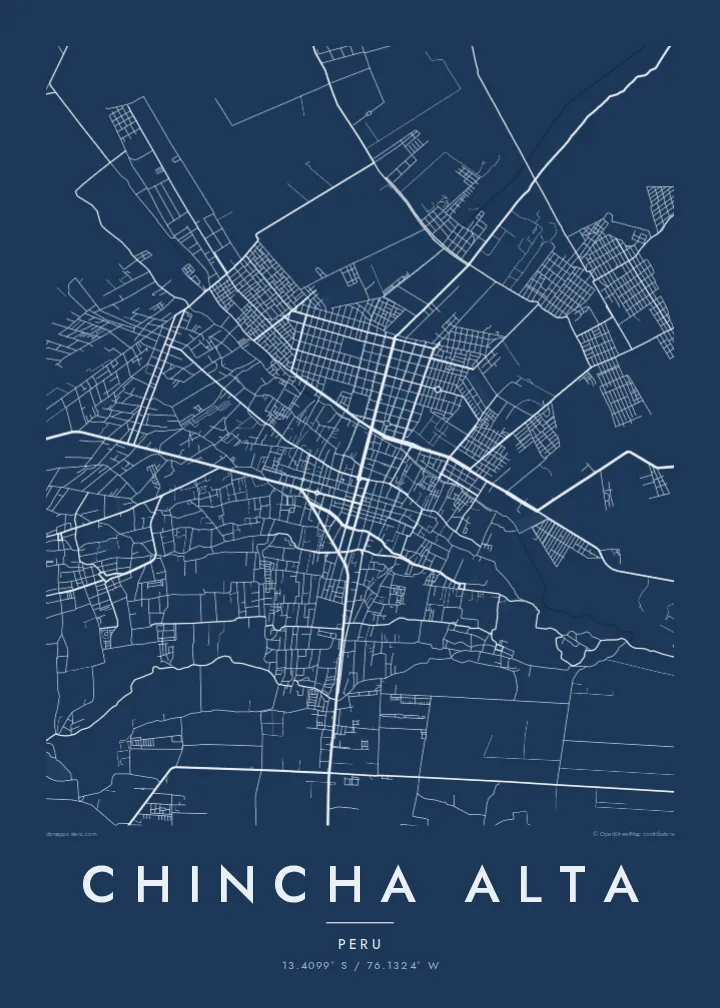
The city sits in an irrigated valley between desert hills and the ocean. The contrast between the dense urban blocks and the surrounding farmland shapes the whole composition.
Fakatino mape mukamuka · Peru
13.4099° S / 76.1324° W
A dense valley town on Peru's desert coast, ringed by irrigated fields and vineyards a short distance from the Pacific.



Taha e taone, lima e onoonoaga
Tapaki e taha puhala ke kitia ai ki luga he puipui. Kua tatai e totogi he tau puhala oti — pete he lolomi, poloka, po ke faila HD.
 Tau pikselo mooli · faila lolomi 24 × 36″
Maama mitaki ke lolomi
Ko e 100% e fahi mooli mai he faila lolomi. Ko e tau poster oti — pete kua lolomi, poloka, po ke utu hifo — kua taute ke he ha mautolu a tau tokoluga (server) ke he 300 DPI, hokotia ke he 7,200 × 10,800 piksela, ke maeke ai e tau ala ikiiki tote ke maaliali fakamitaki he lolomi 24 × 36″.
He Pā


Ko e mape
Chincha Alta is the main city of Chincha Province in the Ica Region, on the southern coast of Peru. It sits a few kilometres inland from the Pacific, in a river valley that stands out as a green oasis against the surrounding desert. From above, the urban area is compact, with streets packed densely around the centre and the Pan-American Highway running nearby, linking it to Lima in the north and Ica in the south.
Chincha is widely regarded as the heartland of Afro-Peruvian culture, with music and dance traditions centred on the nearby district of El Carmen. The valley is also known for grape growing and pisco. Before the Spanish arrived, the area was home to the Chincha, a seafaring and trading society later absorbed into the Inca empire.
The Chincha Alta map poster captures the city as a dense island of streets inside a patchwork of fields. Farm roads and irrigation channels create a soft, lined texture around the urban core, and the highway draws a strong stroke across the composition. At a wider scale, the map shows the whole valley reaching toward the coast.
The city sits in an irrigated valley between desert hills and the ocean. The contrast between the dense urban blocks and the surrounding farmland shapes the whole composition.
The main north–south road of the Peruvian coast passes the city, drawing a long straight line through the map and connecting Chincha with Lima and the rest of the coast.
El Carmen, southeast of the city, is known for festivals and music traditions that draw visitors every year. On wider maps it appears as a small settlement among the fields.
Taute ke ha hau
Lafi e aho, taha higoa po ke taha kupu haau, hiki e fakatino, lahi po ke tuaga.
Ko e kitiaaga nakai totogi kua tote e maaliali mo e fakamailoga vai. Ko e tau lolomi mo e tau faila HD kua taute ke he 300 DPI, hokotia ke he 7,200 × 10,800 px, nakai fai fakamailoga vai.
Ko e ha Chincha Alta
Chincha Alta speaks to people with family in the valley, to those who travelled south for the music and the pisco, and to Peruvians abroad who want the shape of their town on the wall. The compact centre looks especially good in the larger print sizes.
Personalise the title and subtitle, perhaps with a surname or a festival year, and edit the coordinates line. Choose among five styles, from Noir to Sand. Digital files include six sizes, and printed posters arrive on matte paper with an optional wooden frame.
Talaage e poster Chincha Alta| Lahi he lolomi | Maama | Tau faila |
|---|---|---|
| 30 × 40 cm11.8 × 15.7″ | 3,543 × 4,724 px | PNG · PDF |
| 29.7 × 42 cm (A3)11.7 × 16.5″ | 3,508 × 4,961 px | PNG · PDF |
| 42 × 59.4 cm (A2)16.5 × 23.4″ | 4,961 × 7,016 px | PNG · PDF |
| 45.7 × 61 cm18 × 24″ | 5,400 × 7,200 px | PNG · PDF |
| 50 × 70 cm19.7 × 27.6″ | 5,906 × 8,268 px | PNG · PDF |
| 61 × 91.4 cm24 × 36″ | 7,200 × 10,800 px | PNG · PDF |
Ke fakatatai, ko e fakatino noa kua 900 px e laulahi, fai fakamailoga mo e mo e tau mata komipiuta ni. Ko e tau faila HD kua ato hoko ke he 8× e maama ke he tau faahi takitaha mo e lolomi mitaki he lahi katoa he fakatino.
Fifili e taha puhala i luga he kupega, ti fifili e Poster Lolomi — e lahi mo e, kaeke ke manako ai koe, taha poloka — po ke Tau Faila HD Fakaeletonika. Ko e fakaotiaga totogi ko e taha gahua ni, ti ko e kupega he hau a talaaga ka fakafou fakahaga i mua he fakaotiaga e totogi.
Kua lolomi ai ke he pepa mitaki 200 gsm matte he taha he tau lahi ono, mai he 30 × 40 cm ke hoko ke he 24 × 36″. Kamata e tau poster lolomi mai he $39, kua putoia ai e utaaga.
E. Fifili e poloka akau malolō ke he lanu uli, tea, akau oki mooli, po ke akau pouli. Kua fakalataha mo e sioga malolō nakai malepe ti kua mautali ke tautau. Kamata e tau poster poloka mai he $99, kua putoia ai e utaaga.
Nakai totogi e fakafano ke he motu 60+. Ko e fakatino taha kua lolomi he fenoga lolomi ha mautolu kua tata mo e tau motu 30+, kua hoko mai he tau aho gahua 3–7. Maeke ia koe ke kikite e tuaga mo e fakamuitua he lalo he Haku Tau Fakatonu. Ke he falu motu kua 2–5 e tau tapu, ti ka nakai fakafano a mautolu ki ai, to fakaha he api tupe ia ki mua he totogi.
Fakafano mai e taha ata ki a mautolu he loto he 14 e tau aho tali mai he hokoaga, ti to lolomi foki e mautolu nakai totogi po ke liu atu e totogi ki a koe.
E. He editor i luga he kupega nei, hikihiki e matakupu, e matakupu lalo mo e laini coordinates ke he taha mena kua manako a koe ki ai, ti fifili e puhala mo e lahi. Ko e tau talaaga lolomi, poloka mo e fakaeletonika oti kua fakaaoga tonu e hau a fakatino.
Ma e $9 ka moua e koe e tau faila PNG 300 DPI mo e PDF kua mautali ke lolomi he tau lahi ono oti, nakai fai fakamailoga vai, ke lolomi i fe mena. Nakai maopoopo agaia? Utu hifo fakamua e kitiaaga nakai totogi ne fai fakamailoga vai.
Tata mai
