Plaza de Armas
The main square sits at the heart of the colonial grid, a single open block surrounded by the tightest and most regular streets in the city.
Fakatino mape mukamuka · Peru
13.1638° S / 74.2234° W
An Andean colonial city of chequerboard blocks and church towers, set high in a dry mountain valley of south-central Peru.
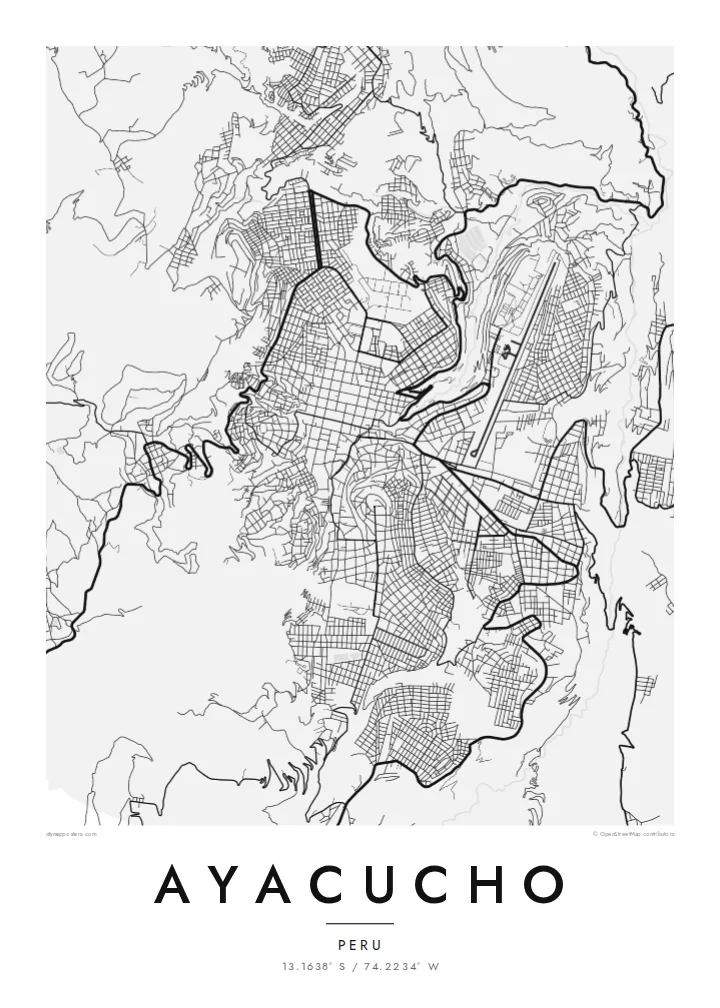


Taha e taone, lima e onoonoaga
Tapaki e taha puhala ke kitia ai ki luga he puipui. Kua tatai e totogi he tau puhala oti — pete he lolomi, poloka, po ke faila HD.
 Tau pikselo mooli · faila lolomi 24 × 36″
Maama mitaki ke lolomi
Ko e 100% e fahi mooli mai he faila lolomi. Ko e tau poster oti — pete kua lolomi, poloka, po ke utu hifo — kua taute ke he ha mautolu a tau tokoluga (server) ke he 300 DPI, hokotia ke he 7,200 × 10,800 piksela, ke maeke ai e tau ala ikiiki tote ke maaliali fakamitaki he lolomi 24 × 36″.
He Pā


Ko e mape
The Spanish founded Ayacucho in 1540 as San Juan de la Frontera de Huamanga, and the name Huamanga is still in everyday use. Its historic centre follows the classic Spanish colonial plan. A regular grid of blocks spreads out from the Plaza de Armas, arcaded buildings line the square, and the streets run straight until the hills stop them.
The city is known for its many churches, often counted at thirty-three, a number linked to the age of Christ, and its Holy Week celebrations draw visitors from across Peru. It is also a centre for traditional crafts, including retablos, carved stone and weaving. Many workshops sit in the neighbourhoods around the colonial core.
Nearby, on the Pampa de Quinua, the Battle of Ayacucho in 1824 effectively ended Spanish rule in South America. An Ayacucho map poster shows the ordered centre giving way to newer districts that climb the surrounding slopes, their streets bending with the terrain. The whole city reads as a grid set inside a bowl of mountains.
The main square sits at the heart of the colonial grid, a single open block surrounded by the tightest and most regular streets in the city.
Straight streets meet at right angles across the historic centre, where many of Ayacucho's churches stand. This gives the poster a crisp, orderly core.
Newer neighbourhoods spread up the valley slopes, where the grid loosens and the streets begin to curve, a clear contrast with the planned centre.
Taute ke ha hau
Lafi e aho, taha higoa po ke taha kupu haau, hiki e fakatino, lahi po ke tuaga.
Ko e kitiaaga nakai totogi kua tote e maaliali mo e fakamailoga vai. Ko e tau lolomi mo e tau faila HD kua taute ke he 300 DPI, hokotia ke he 7,200 × 10,800 px, nakai fai fakamailoga vai.
Ko e ha Ayacucho
Ayacucho means a great deal to Peruvians. It is where independence was sealed, and it is a city of faith, music and craft. For anyone from Huamanga, a map of its streets is a piece of home with real weight behind it.
Title it Ayacucho or Huamanga, add a subtitle such as a year or a family name, and adjust the coordinates line. Choose Classic black & white, Noir, Paper, Blueprint or Sand, as $9 digital files or a printed poster.
Talaage e poster Ayacucho| Lahi he lolomi | Maama | Tau faila |
|---|---|---|
| 30 × 40 cm11.8 × 15.7″ | 3,543 × 4,724 px | PNG · PDF |
| 29.7 × 42 cm (A3)11.7 × 16.5″ | 3,508 × 4,961 px | PNG · PDF |
| 42 × 59.4 cm (A2)16.5 × 23.4″ | 4,961 × 7,016 px | PNG · PDF |
| 45.7 × 61 cm18 × 24″ | 5,400 × 7,200 px | PNG · PDF |
| 50 × 70 cm19.7 × 27.6″ | 5,906 × 8,268 px | PNG · PDF |
| 61 × 91.4 cm24 × 36″ | 7,200 × 10,800 px | PNG · PDF |
Ke fakatatai, ko e fakatino noa kua 900 px e laulahi, fai fakamailoga mo e mo e tau mata komipiuta ni. Ko e tau faila HD kua ato hoko ke he 8× e maama ke he tau faahi takitaha mo e lolomi mitaki he lahi katoa he fakatino.
Fifili e taha puhala i luga he kupega, ti fifili e Poster Lolomi — e lahi mo e, kaeke ke manako ai koe, taha poloka — po ke Tau Faila HD Fakaeletonika. Ko e fakaotiaga totogi ko e taha gahua ni, ti ko e kupega he hau a talaaga ka fakafou fakahaga i mua he fakaotiaga e totogi.
Kua lolomi ai ke he pepa mitaki 200 gsm matte he taha he tau lahi ono, mai he 30 × 40 cm ke hoko ke he 24 × 36″. Kamata e tau poster lolomi mai he $39, kua putoia ai e utaaga.
E. Fifili e poloka akau malolō ke he lanu uli, tea, akau oki mooli, po ke akau pouli. Kua fakalataha mo e sioga malolō nakai malepe ti kua mautali ke tautau. Kamata e tau poster poloka mai he $99, kua putoia ai e utaaga.
Nakai totogi e fakafano ke he motu 60+. Ko e fakatino taha kua lolomi he fenoga lolomi ha mautolu kua tata mo e tau motu 30+, kua hoko mai he tau aho gahua 3–7. Maeke ia koe ke kikite e tuaga mo e fakamuitua he lalo he Haku Tau Fakatonu. Ke he falu motu kua 2–5 e tau tapu, ti ka nakai fakafano a mautolu ki ai, to fakaha he api tupe ia ki mua he totogi.
Fakafano mai e taha ata ki a mautolu he loto he 14 e tau aho tali mai he hokoaga, ti to lolomi foki e mautolu nakai totogi po ke liu atu e totogi ki a koe.
E. He editor i luga he kupega nei, hikihiki e matakupu, e matakupu lalo mo e laini coordinates ke he taha mena kua manako a koe ki ai, ti fifili e puhala mo e lahi. Ko e tau talaaga lolomi, poloka mo e fakaeletonika oti kua fakaaoga tonu e hau a fakatino.
Ma e $9 ka moua e koe e tau faila PNG 300 DPI mo e PDF kua mautali ke lolomi he tau lahi ono oti, nakai fai fakamailoga vai, ke lolomi i fe mena. Nakai maopoopo agaia? Utu hifo fakamua e kitiaaga nakai totogi ne fai fakamailoga vai.
