Ancestral Temple
The Zumiao temple complex in Chancheng, with its courtyards and ceremonial halls. It sits within a compact grid of older streets, a quieter pocket inside the wider city.
Fakatino mape mukamuka · China
23.0268° N / 113.1315° E
A river-laced city beside Guangzhou, where delta channels thread between old temple streets, ceramics quarters and dense new grids.
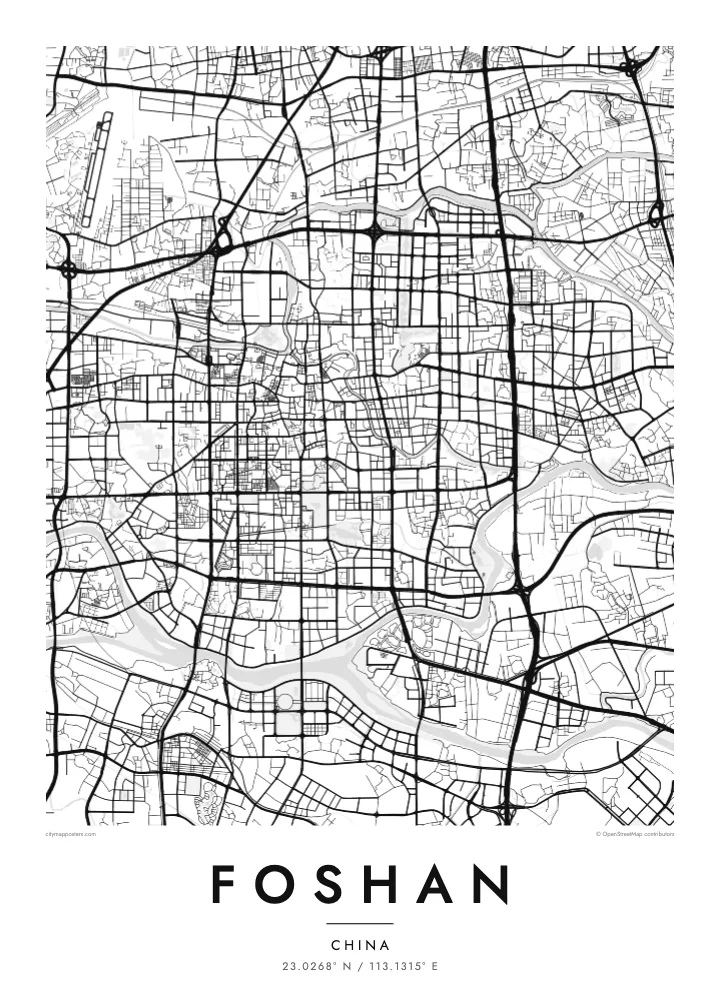
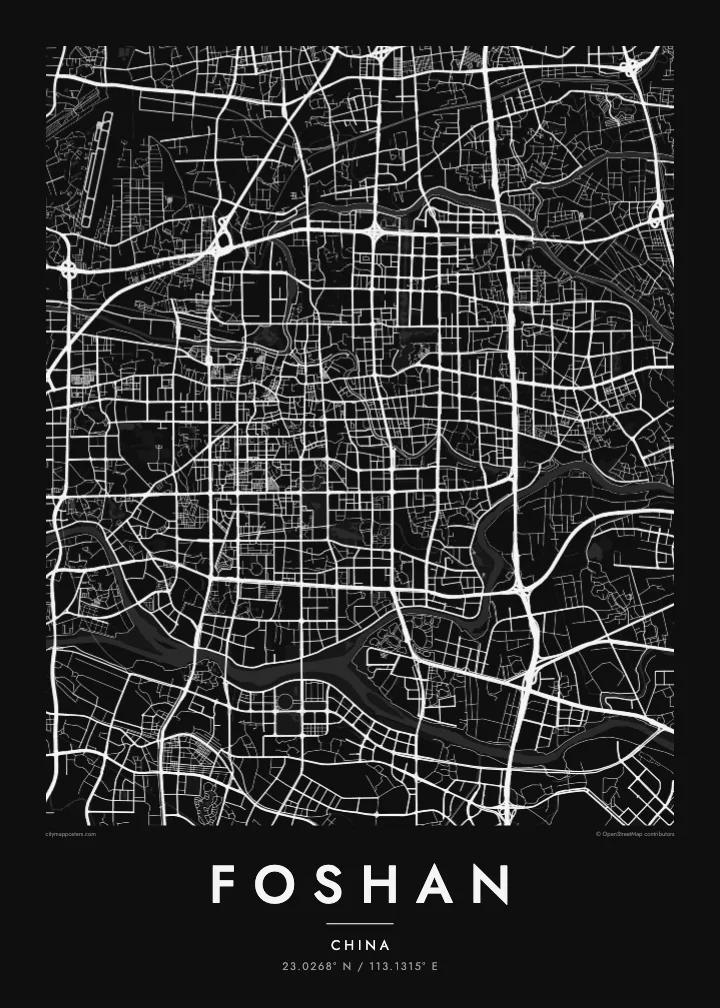
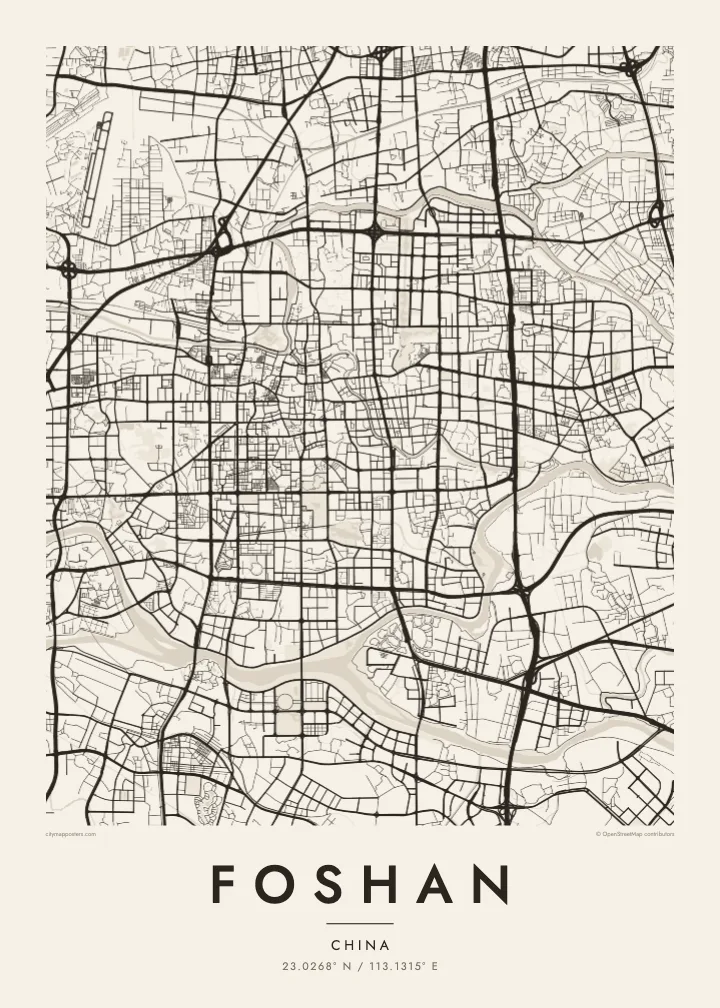

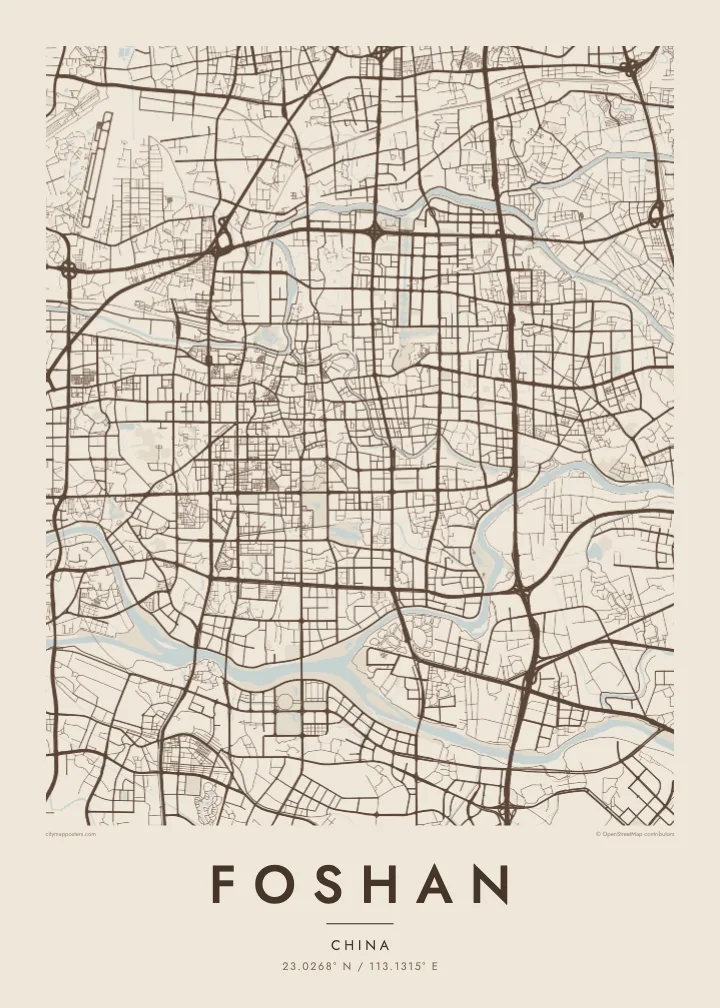
Taha e taone, lima e onoonoaga
Tapaki e taha puhala ke kitia ai ki luga he puipui. Kua tatai e totogi he tau puhala oti — pete he lolomi, poloka, po ke faila HD.
 Tau pikselo mooli · faila lolomi 24 × 36″
Maama mitaki ke lolomi
Ko e 100% e fahi mooli mai he faila lolomi. Ko e tau poster oti — pete kua lolomi, poloka, po ke utu hifo — kua taute ke he ha mautolu a tau tokoluga (server) ke he 300 DPI, hokotia ke he 7,200 × 10,800 piksela, ke maeke ai e tau ala ikiiki tote ke maaliali fakamitaki he lolomi 24 × 36″.
He Pā


Ko e mape
Foshan lies immediately west and southwest of Guangzhou in the Pearl River Delta, and on the map the two cities run into each other with no visible break. The land is laced with water: branches of the Xi and Bei rivers, smaller channels and fish ponds break the street pattern into islands and peninsulas, especially in the southern districts toward Shunde.
The old centre of Chancheng is organised around the Foshan Ancestral Temple, a Taoist temple complex first built in the Song dynasty and rebuilt many times since. Nearby, the Shiwan area has made ceramics for centuries. The city is also closely linked with martial arts; Wong Fei-hung and Ip Man were both born here, and a Foshan map poster covers the ground where both grew up.
Foshan's urban area is in fact several districts joined together, Chancheng, Nanhai, Shunde and others, each with its own centre. The Guangfo metro line, opened in 2010, was one of the first in China to link two cities directly. From above, the effect is a continuous, dense fabric divided mainly by water, which suits a monochrome print particularly well.
The Zumiao temple complex in Chancheng, with its courtyards and ceremonial halls. It sits within a compact grid of older streets, a quieter pocket inside the wider city.
River branches and man-made channels split the southern districts into separate pieces, and many small ponds survive between buildings, creating a fragmented, island-like pattern across the lower part of the map.
Foshan's eastern side meets Guangzhou without a visible boundary. A wider frame shows the two cities merging, joined by bridges, rail lines and continuous streets.
Taute ke ha hau
Lafi e aho, taha higoa po ke taha kupu haau, hiki e fakatino, lahi po ke tuaga.
Ko e kitiaaga nakai totogi kua tote e maaliali mo e fakamailoga vai. Ko e tau lolomi mo e tau faila HD kua taute ke he 300 DPI, hokotia ke he 7,200 × 10,800 px, nakai fai fakamailoga vai.
Ko e ha Foshan
Foshan is known for its food, its kung fu schools and its craftsmanship, and many people from Shunde or Nanhai keep a strong sense of home. A map of the city shows where that sense comes from: water, old temples and close streets.
Personalise the title with your district, a family name or a date, and pick one of five styles. Paper suits the ceramic and craft associations; Noir gives the channels a dark, graphic weight. Download HD files in six sizes, or order a framed print.
Talaage e poster Foshan| Lahi he lolomi | Maama | Tau faila |
|---|---|---|
| 30 × 40 cm11.8 × 15.7″ | 3,543 × 4,724 px | PNG · PDF |
| 29.7 × 42 cm (A3)11.7 × 16.5″ | 3,508 × 4,961 px | PNG · PDF |
| 42 × 59.4 cm (A2)16.5 × 23.4″ | 4,961 × 7,016 px | PNG · PDF |
| 45.7 × 61 cm18 × 24″ | 5,400 × 7,200 px | PNG · PDF |
| 50 × 70 cm19.7 × 27.6″ | 5,906 × 8,268 px | PNG · PDF |
| 61 × 91.4 cm24 × 36″ | 7,200 × 10,800 px | PNG · PDF |
Ke fakatatai, ko e fakatino noa kua 900 px e laulahi, fai fakamailoga mo e mo e tau mata komipiuta ni. Ko e tau faila HD kua ato hoko ke he 8× e maama ke he tau faahi takitaha mo e lolomi mitaki he lahi katoa he fakatino.
Fifili e taha puhala i luga he kupega, ti fifili e Poster Lolomi — e lahi mo e, kaeke ke manako ai koe, taha poloka — po ke Tau Faila HD Fakaeletonika. Ko e fakaotiaga totogi ko e taha gahua ni, ti ko e kupega he hau a talaaga ka fakafou fakahaga i mua he fakaotiaga e totogi.
Kua lolomi ai ke he pepa mitaki 200 gsm matte he taha he tau lahi ono, mai he 30 × 40 cm ke hoko ke he 24 × 36″. Kamata e tau poster lolomi mai he $39, kua putoia ai e utaaga.
E. Fifili e poloka akau malolō ke he lanu uli, tea, akau oki mooli, po ke akau pouli. Kua fakalataha mo e sioga malolō nakai malepe ti kua mautali ke tautau. Kamata e tau poster poloka mai he $99, kua putoia ai e utaaga.
Nakai totogi e fakafano ke he motu 60+. Ko e fakatino taha kua lolomi he fenoga lolomi ha mautolu kua tata mo e tau motu 30+, kua hoko mai he tau aho gahua 3–7. Maeke ia koe ke kikite e tuaga mo e fakamuitua he lalo he Haku Tau Fakatonu. Ke he falu motu kua 2–5 e tau tapu, ti ka nakai fakafano a mautolu ki ai, to fakaha he api tupe ia ki mua he totogi.
Fakafano mai e taha ata ki a mautolu he loto he 14 e tau aho tali mai he hokoaga, ti to lolomi foki e mautolu nakai totogi po ke liu atu e totogi ki a koe.
E. He editor i luga he kupega nei, hikihiki e matakupu, e matakupu lalo mo e laini coordinates ke he taha mena kua manako a koe ki ai, ti fifili e puhala mo e lahi. Ko e tau talaaga lolomi, poloka mo e fakaeletonika oti kua fakaaoga tonu e hau a fakatino.
Ma e $9 ka moua e koe e tau faila PNG 300 DPI mo e PDF kua mautali ke lolomi he tau lahi ono oti, nakai fai fakamailoga vai, ke lolomi i fe mena. Nakai maopoopo agaia? Utu hifo fakamua e kitiaaga nakai totogi ne fai fakamailoga vai.
Tata mai
