Pearl River channels
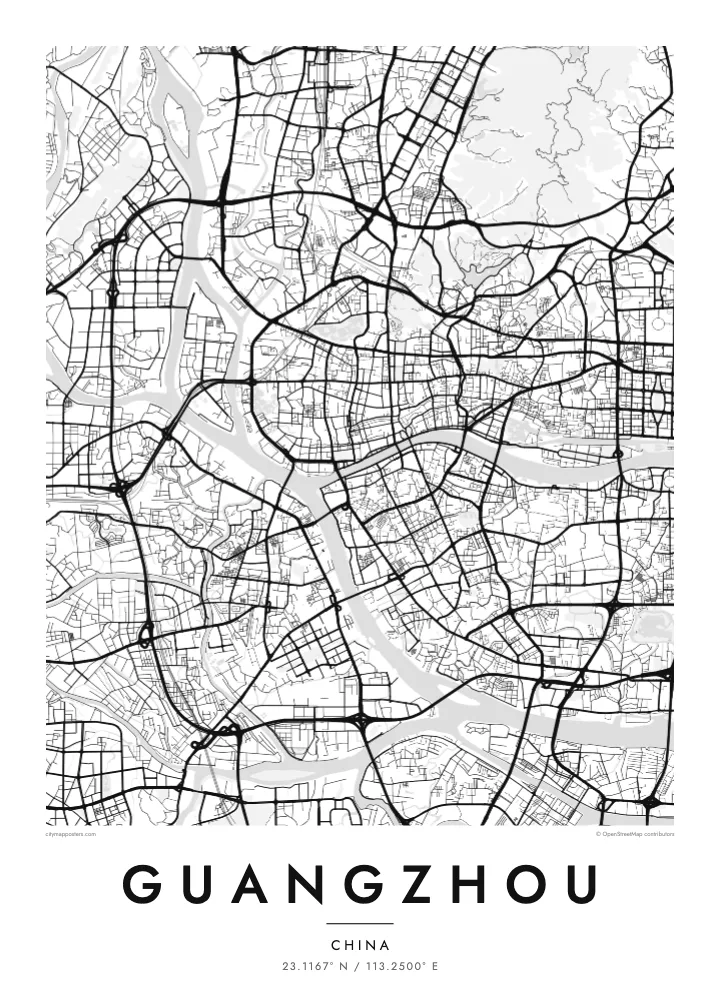
The river splits and rejoins as it crosses the city, leaving islands and peninsulas between its branches. These ribbons of water give the poster its main structure and divide north from south.
Fakatino mape mukamuka · China
23.1167° N / 113.2500° E
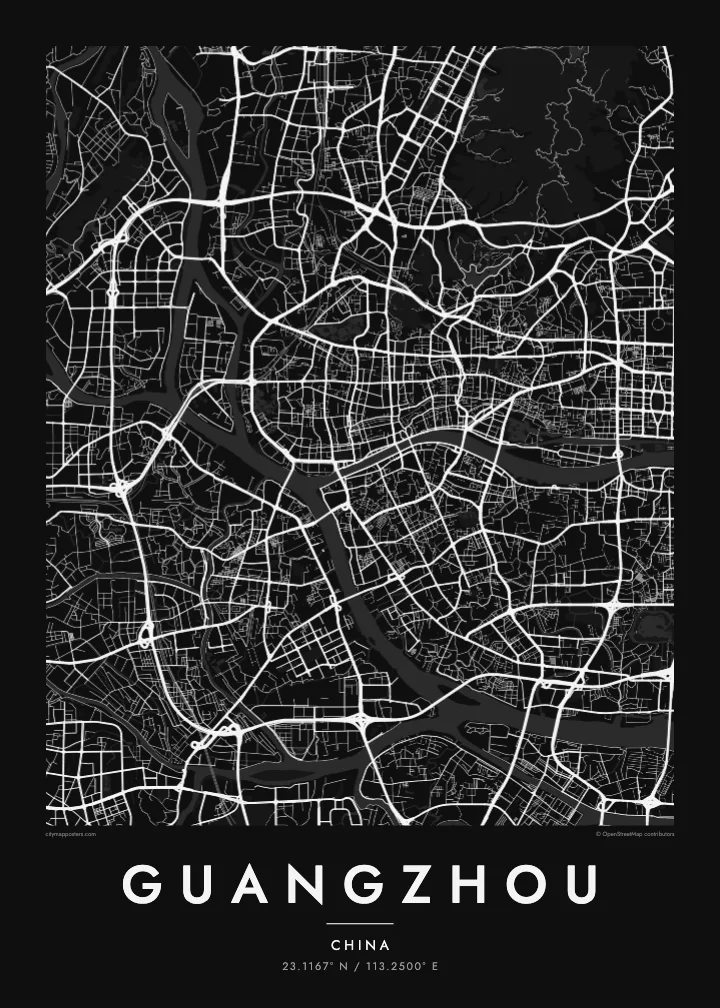
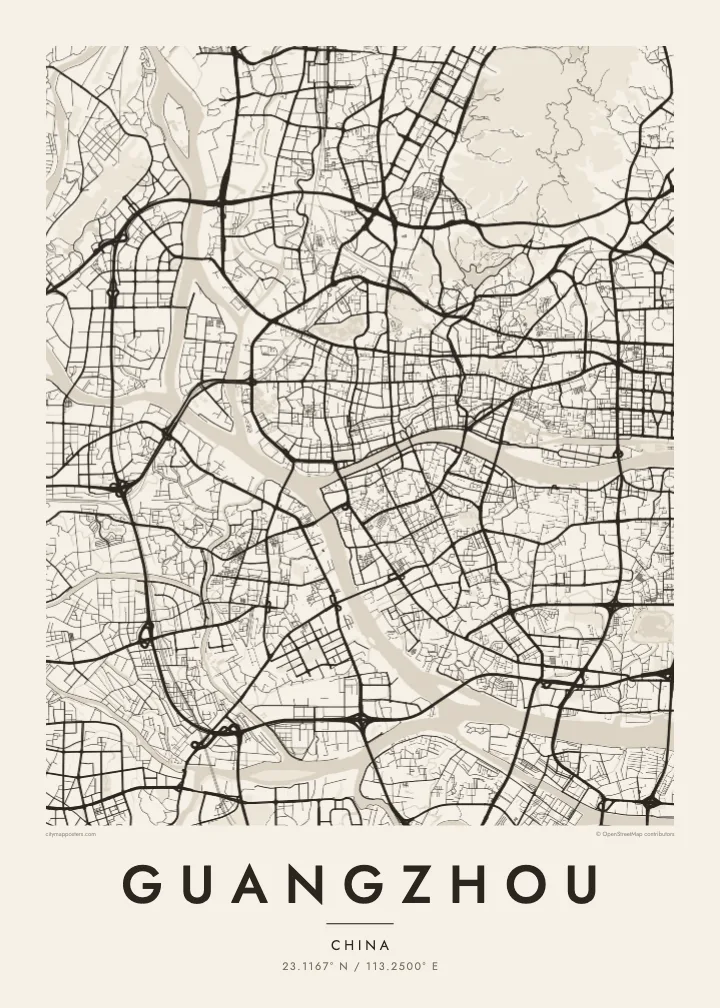
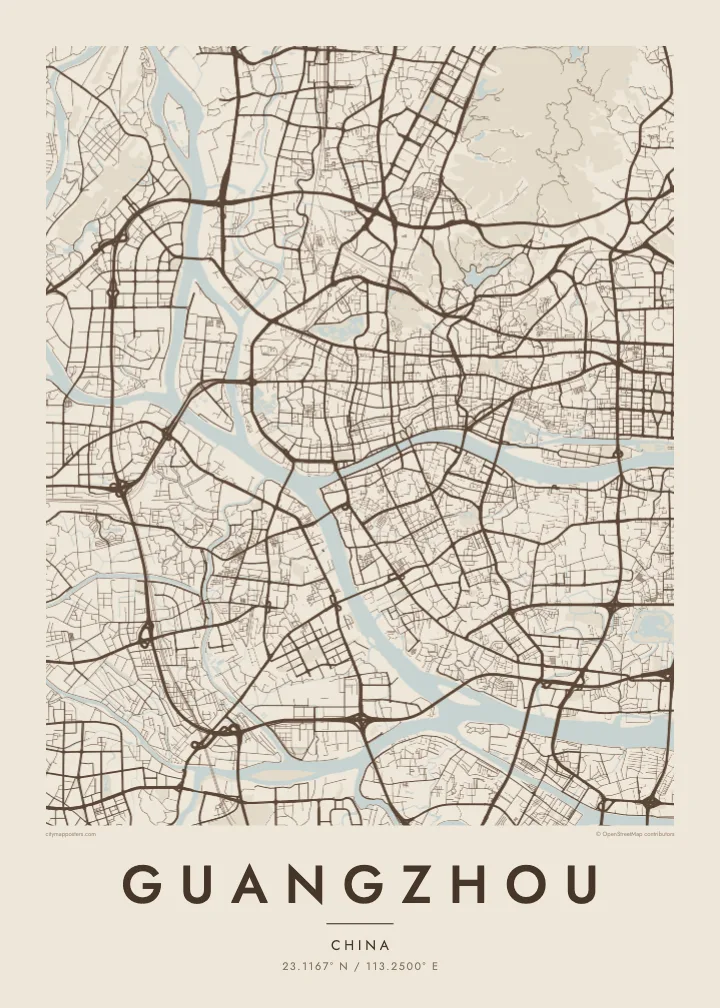
A dense river city where the Pearl River splits around islands, with the slopes of Baiyun Mountain holding back the streets to the north

Taha e taone, lima e onoonoaga
Tapaki e taha puhala ke kitia ai ki luga he puipui. Kua tatai e totogi he tau puhala oti — pete he lolomi, poloka, po ke faila HD.
 Tau pikselo mooli · faila lolomi 24 × 36″
Maama mitaki ke lolomi
Ko e 100% e fahi mooli mai he faila lolomi. Ko e tau poster oti — pete kua lolomi, poloka, po ke utu hifo — kua taute ke he ha mautolu a tau tokoluga (server) ke he 300 DPI, hokotia ke he 7,200 × 10,800 piksela, ke maeke ai e tau ala ikiiki tote ke maaliali fakamitaki he lolomi 24 × 36″.
He Pā


Ko e mape
Guangzhou is organised around water. The Pearl River runs through the city from west to east, and its channels divide the urban area into distinct banks and islands. Haizhu, on the south side, is a district entirely wrapped by river branches, and further downstream the delta begins to widen toward the sea. On a map, bridges cross these channels at close intervals, stitching the halves of the city together.
The older districts of Liwan and Yuexiu hold the historic core, with an irregular, closely packed street pattern. Small Shamian Island, once a foreign concession, appears as a neat elongated shape on the river’s edge. To the east, Zhujiang New Town lays down a wide, formal axis that faces the Canton Tower across the water, and the long ridge of Baiyun Mountain closes off the north.
The city, historically known in the West as Canton, has been a trading port for more than two thousand years and was an early hub of maritime trade with Southeast Asia and beyond. The Canton Fair, held here since 1957, remains one of the largest trade fairs in China. A Guangzhou map poster captures that river-bound, commercial character in a single frame.
The river splits and rejoins as it crosses the city, leaving islands and peninsulas between its branches. These ribbons of water give the poster its main structure and divide north from south.
A small island on the river bank in Liwan, laid out with a tidy grid of tree-lined streets. Its regular plan stands out clearly against the tighter lanes of the surrounding old town.
A broad central axis of parks and plazas runs north to south through the business district and continues across the river toward the Canton Tower, giving the modern city a clear ceremonial line.
Taute ke ha hau
Lafi e aho, taha higoa po ke taha kupu haau, hiki e fakatino, lahi po ke tuaga.
Ko e kitiaaga nakai totogi kua tote e maaliali mo e fakamailoga vai. Ko e tau lolomi mo e tau faila HD kua taute ke he 300 DPI, hokotia ke he 7,200 × 10,800 px, nakai fai fakamailoga vai.
Ko e ha Guangzhou
Guangzhou tends to belong to people with a real connection to it, whether through family in Guangdong, years spent studying there or regular trips to the Canton Fair. The river divides the frame into strong shapes, so the poster reads well from across a room.
The title, subtitle and coordinates line are all editable, so the print can carry a name, a district or the date you moved there. Pick one of five styles, Classic black & white, Noir, Paper, Blueprint or Sand, to match the room it will hang in.
Talaage e poster Guangzhou| Lahi he lolomi | Maama | Tau faila |
|---|---|---|
| 30 × 40 cm11.8 × 15.7″ | 3,543 × 4,724 px | PNG · PDF |
| 29.7 × 42 cm (A3)11.7 × 16.5″ | 3,508 × 4,961 px | PNG · PDF |
| 42 × 59.4 cm (A2)16.5 × 23.4″ | 4,961 × 7,016 px | PNG · PDF |
| 45.7 × 61 cm18 × 24″ | 5,400 × 7,200 px | PNG · PDF |
| 50 × 70 cm19.7 × 27.6″ | 5,906 × 8,268 px | PNG · PDF |
| 61 × 91.4 cm24 × 36″ | 7,200 × 10,800 px | PNG · PDF |
Ke fakatatai, ko e fakatino noa kua 900 px e laulahi, fai fakamailoga mo e mo e tau mata komipiuta ni. Ko e tau faila HD kua ato hoko ke he 8× e maama ke he tau faahi takitaha mo e lolomi mitaki he lahi katoa he fakatino.
Fifili e taha puhala i luga he kupega, ti fifili e Poster Lolomi — e lahi mo e, kaeke ke manako ai koe, taha poloka — po ke Tau Faila HD Fakaeletonika. Ko e fakaotiaga totogi ko e taha gahua ni, ti ko e kupega he hau a talaaga ka fakafou fakahaga i mua he fakaotiaga e totogi.
Kua lolomi ai ke he pepa mitaki 200 gsm matte he taha he tau lahi ono, mai he 30 × 40 cm ke hoko ke he 24 × 36″. Kamata e tau poster lolomi mai he $39, kua putoia ai e utaaga.
E. Fifili e poloka akau malolō ke he lanu uli, tea, akau oki mooli, po ke akau pouli. Kua fakalataha mo e sioga malolō nakai malepe ti kua mautali ke tautau. Kamata e tau poster poloka mai he $99, kua putoia ai e utaaga.
Nakai totogi e fakafano ke he motu 60+. Ko e fakatino taha kua lolomi he fenoga lolomi ha mautolu kua tata mo e tau motu 30+, kua hoko mai he tau aho gahua 3–7. Maeke ia koe ke kikite e tuaga mo e fakamuitua he lalo he Haku Tau Fakatonu. Ke he falu motu kua 2–5 e tau tapu, ti ka nakai fakafano a mautolu ki ai, to fakaha he api tupe ia ki mua he totogi.
Fakafano mai e taha ata ki a mautolu he loto he 14 e tau aho tali mai he hokoaga, ti to lolomi foki e mautolu nakai totogi po ke liu atu e totogi ki a koe.
E. He editor i luga he kupega nei, hikihiki e matakupu, e matakupu lalo mo e laini coordinates ke he taha mena kua manako a koe ki ai, ti fifili e puhala mo e lahi. Ko e tau talaaga lolomi, poloka mo e fakaeletonika oti kua fakaaoga tonu e hau a fakatino.
Ma e $9 ka moua e koe e tau faila PNG 300 DPI mo e PDF kua mautali ke lolomi he tau lahi ono oti, nakai fai fakamailoga vai, ke lolomi i fe mena. Nakai maopoopo agaia? Utu hifo fakamua e kitiaaga nakai totogi ne fai fakamailoga vai.
Tata mai
