Regular street grid
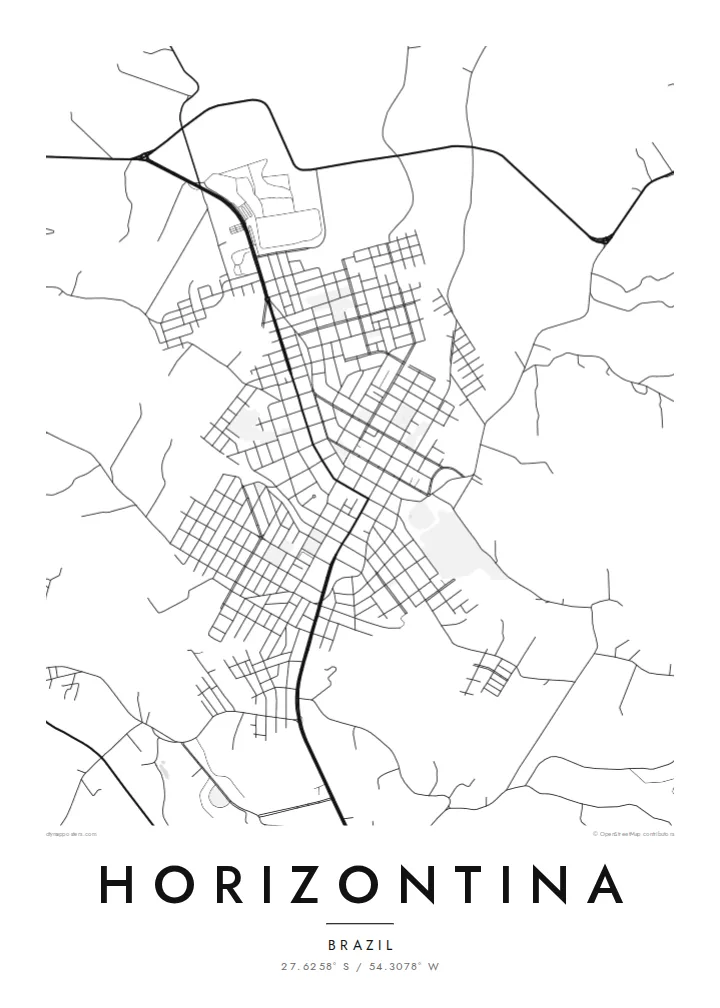
The centre is laid out in straight streets crossing at regular intervals, giving the map an even, rectangular pattern typical of planned towns in the interior of Rio Grande do Sul.
Fakatino mape mukamuka · Brazil
27.6258° S / 54.3078° W
An orderly farm-country town in northwest Rio Grande do Sul, its straight streets set among open agricultural land.


Taha e taone, lima e onoonoaga
Tapaki e taha puhala ke kitia ai ki luga he puipui. Kua tatai e totogi he tau puhala oti — pete he lolomi, poloka, po ke faila HD.
 Tau pikselo mooli · faila lolomi 24 × 36″
Maama mitaki ke lolomi
Ko e 100% e fahi mooli mai he faila lolomi. Ko e tau poster oti — pete kua lolomi, poloka, po ke utu hifo — kua taute ke he ha mautolu a tau tokoluga (server) ke he 300 DPI, hokotia ke he 7,200 × 10,800 piksela, ke maeke ai e tau ala ikiiki tote ke maaliali fakamitaki he lolomi 24 × 36″.
He Pā


Ko e mape
Horizontina is a small city in the northwest of Rio Grande do Sul, in the rolling farmland not far from the Uruguay River and the border with Argentina. The region was settled largely by families of European descent in the twentieth century, and agriculture has shaped both its economy and its landscape ever since.
The town is closely associated with farm machinery. A large agricultural equipment factory, operated today by John Deere, has been central to local industry for decades and is a major employer. Horizontina is also widely known as the birthplace of the model Gisele Bündchen, a fact that brought the town national and international attention.
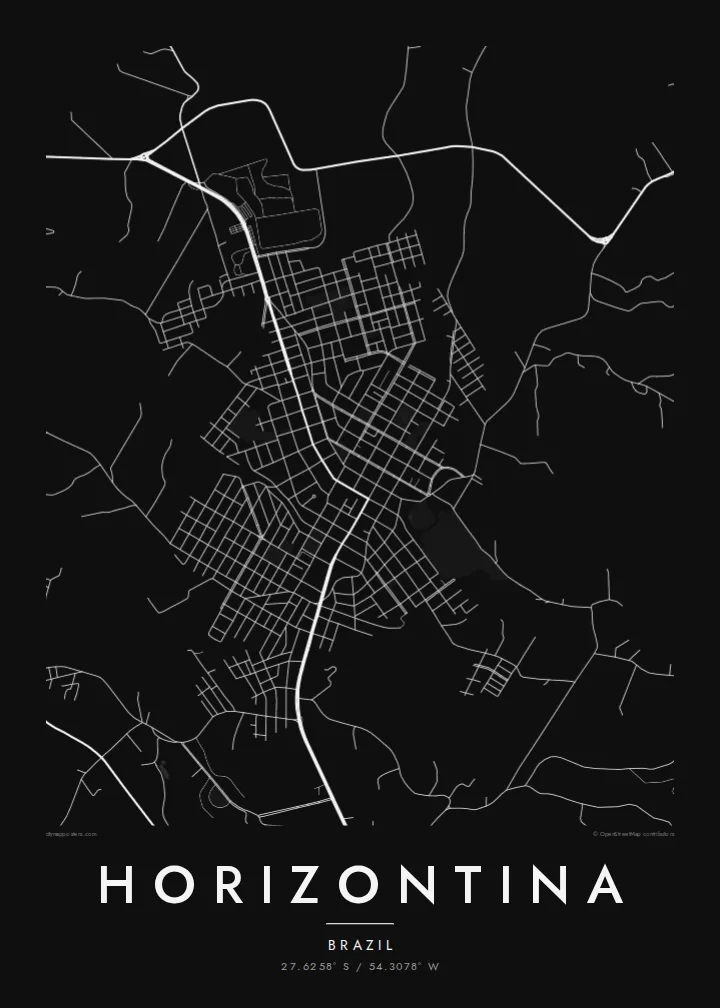
From above, Horizontina has the clear, planned look of many towns in southern Brazil's interior. Streets run in straight lines and meet at regular intersections, forming a tidy centre that thins out at the edges into roads leading to surrounding farms. A Horizontina map poster reduces this to its essentials: a neat grid, a few longer routes out of town, and the open country beyond.
The centre is laid out in straight streets crossing at regular intervals, giving the map an even, rectangular pattern typical of planned towns in the interior of Rio Grande do Sul.
The large agricultural machinery works occupies its own substantial footprint beside the town, a broad block that contrasts with the finer residential streets nearby.
At the edges the grid gives way to longer rural roads running out across the surrounding fields, a reminder of how closely the town is tied to agriculture.
Taute ke ha hau
Lafi e aho, taha higoa po ke taha kupu haau, hiki e fakatino, lahi po ke tuaga.
Ko e kitiaaga nakai totogi kua tote e maaliali mo e fakamailoga vai. Ko e tau lolomi mo e tau faila HD kua taute ke he 300 DPI, hokotia ke he 7,200 × 10,800 px, nakai fai fakamailoga vai.
Ko e ha Horizontina
A Horizontina map is a fitting gift for anyone who grew up here, worked at the factory, or left for a larger city and still thinks of the town as home. Its clean grid makes a balanced, graphic poster that sits comfortably in almost any room.
Personalise the title, subtitle and coordinates line, perhaps with a family name or the year you moved away, and choose from five styles. The $9 digital files include six sizes as 300 DPI PNG and print-ready PDF, or order a printed poster with an optional wooden frame.
Talaage e poster Horizontina| Lahi he lolomi | Maama | Tau faila |
|---|---|---|
| 30 × 40 cm11.8 × 15.7″ | 3,543 × 4,724 px | PNG · PDF |
| 29.7 × 42 cm (A3)11.7 × 16.5″ | 3,508 × 4,961 px | PNG · PDF |
| 42 × 59.4 cm (A2)16.5 × 23.4″ | 4,961 × 7,016 px | PNG · PDF |
| 45.7 × 61 cm18 × 24″ | 5,400 × 7,200 px | PNG · PDF |
| 50 × 70 cm19.7 × 27.6″ | 5,906 × 8,268 px | PNG · PDF |
| 61 × 91.4 cm24 × 36″ | 7,200 × 10,800 px | PNG · PDF |
Ke fakatatai, ko e fakatino noa kua 900 px e laulahi, fai fakamailoga mo e mo e tau mata komipiuta ni. Ko e tau faila HD kua ato hoko ke he 8× e maama ke he tau faahi takitaha mo e lolomi mitaki he lahi katoa he fakatino.
Fifili e taha puhala i luga he kupega, ti fifili e Poster Lolomi — e lahi mo e, kaeke ke manako ai koe, taha poloka — po ke Tau Faila HD Fakaeletonika. Ko e fakaotiaga totogi ko e taha gahua ni, ti ko e kupega he hau a talaaga ka fakafou fakahaga i mua he fakaotiaga e totogi.
Kua lolomi ai ke he pepa mitaki 200 gsm matte he taha he tau lahi ono, mai he 30 × 40 cm ke hoko ke he 24 × 36″. Kamata e tau poster lolomi mai he $39, kua putoia ai e utaaga.
E. Fifili e poloka akau malolō ke he lanu uli, tea, akau oki mooli, po ke akau pouli. Kua fakalataha mo e sioga malolō nakai malepe ti kua mautali ke tautau. Kamata e tau poster poloka mai he $99, kua putoia ai e utaaga.
Nakai totogi e fakafano ke he motu 60+. Ko e fakatino taha kua lolomi he fenoga lolomi ha mautolu kua tata mo e tau motu 30+, kua hoko mai he tau aho gahua 3–7. Maeke ia koe ke kikite e tuaga mo e fakamuitua he lalo he Haku Tau Fakatonu. Ke he falu motu kua 2–5 e tau tapu, ti ka nakai fakafano a mautolu ki ai, to fakaha he api tupe ia ki mua he totogi.
Fakafano mai e taha ata ki a mautolu he loto he 14 e tau aho tali mai he hokoaga, ti to lolomi foki e mautolu nakai totogi po ke liu atu e totogi ki a koe.
E. He editor i luga he kupega nei, hikihiki e matakupu, e matakupu lalo mo e laini coordinates ke he taha mena kua manako a koe ki ai, ti fifili e puhala mo e lahi. Ko e tau talaaga lolomi, poloka mo e fakaeletonika oti kua fakaaoga tonu e hau a fakatino.
Ma e $9 ka moua e koe e tau faila PNG 300 DPI mo e PDF kua mautali ke lolomi he tau lahi ono oti, nakai fai fakamailoga vai, ke lolomi i fe mena. Nakai maopoopo agaia? Utu hifo fakamua e kitiaaga nakai totogi ne fai fakamailoga vai.
Tata mai
