The Maidan
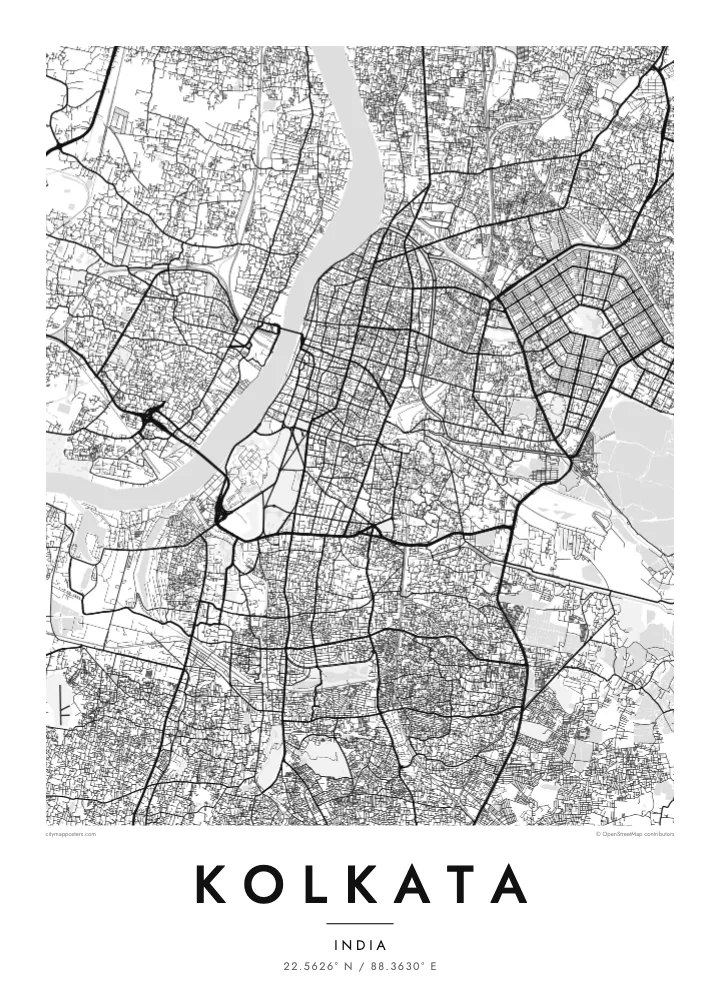
The great open ground at the centre of the city forms the largest blank space on the map, bordered by Chowringhee on one side and Fort William on the other.
Fakatino mape mukamuka · India
22.5626° N / 88.3630° E
A city stretched along the east bank of the Hooghly, with a great open Maidan at its heart and bridges reaching across.



Taha e taone, lima e onoonoaga
Tapaki e taha puhala ke kitia ai ki luga he puipui. Kua tatai e totogi he tau puhala oti — pete he lolomi, poloka, po ke faila HD.
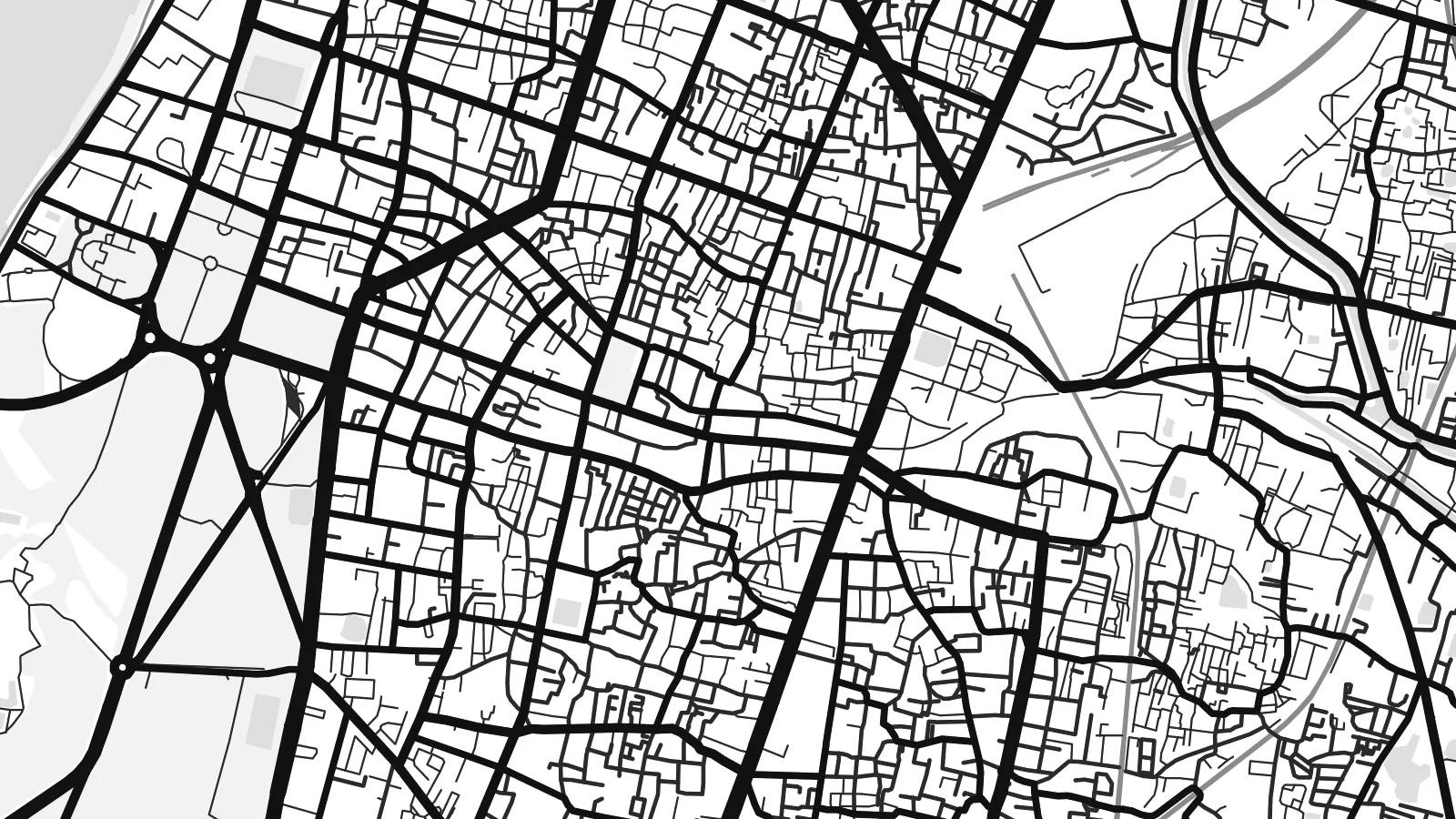 Tau pikselo mooli · faila lolomi 24 × 36″
Maama mitaki ke lolomi
Ko e 100% e fahi mooli mai he faila lolomi. Ko e tau poster oti — pete kua lolomi, poloka, po ke utu hifo — kua taute ke he ha mautolu a tau tokoluga (server) ke he 300 DPI, hokotia ke he 7,200 × 10,800 piksela, ke maeke ai e tau ala ikiiki tote ke maaliali fakamitaki he lolomi 24 × 36″.
He Pā


Ko e mape
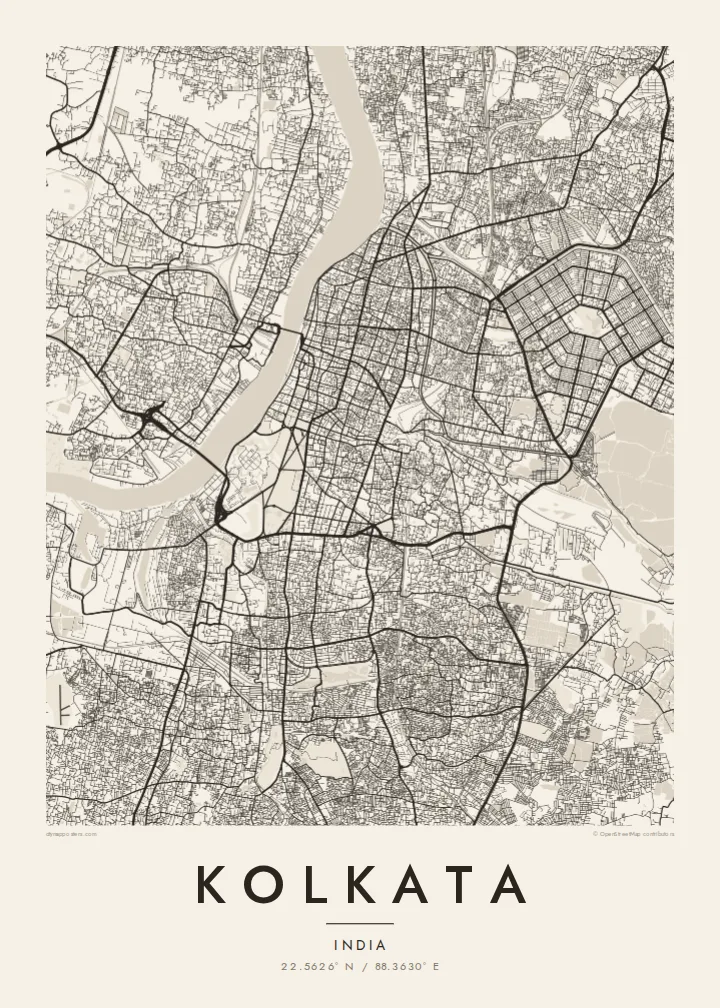
Kolkata grew along the eastern bank of the Hooghly River, and the map follows that orientation: the city is long from north to south and relatively narrow from east to west. The river curves along its western edge, with Howrah on the opposite bank. Streets in the older northern quarters are dense and irregular, while the southern districts become gradually more open.
At the centre lies the Maidan, a vast open ground that appears as a large empty space in the middle of the street pattern. The Victoria Memorial sits at its southern end and Fort William on its western side, close to the river. To the east, Salt Lake City, or Bidhannagar, was laid out as a planned grid of sectors.
Kolkata was the capital of British India until 1911 and remains a major centre of literature and film. Howrah Bridge, a large cantilever structure opened in 1943, and the later Vidyasagar Setu cross the Hooghly. A Kolkata map poster shows the river, the Maidan and the dense fabric of streets in a single, balanced frame.
The great open ground at the centre of the city forms the largest blank space on the map, bordered by Chowringhee on one side and Fort William on the other.
The cantilever bridge links Kolkata with Howrah across the Hooghly and is one of the city's most recognisable landmarks, a firm line drawn across the river.
The planned township of Bidhannagar, built on reclaimed wetland in the east, shows a regular pattern of sectors and blocks, very different from the older city.
Taute ke ha hau
Lafi e aho, taha higoa po ke taha kupu haau, hiki e fakatino, lahi po ke tuaga.
Ko e kitiaaga nakai totogi kua tote e maaliali mo e fakamailoga vai. Ko e tau lolomi mo e tau faila HD kua taute ke he 300 DPI, hokotia ke he 7,200 × 10,800 px, nakai fai fakamailoga vai.
Ko e ha Kolkata
Kolkata is a city people carry with them, in its streets, its books and its long evenings by the river. A poster that shows the Hooghly curving past the Maidan and the old quarters is a way of keeping that familiarity on the wall.
The title, subtitle and coordinates can all be personalised, so the print can mark a family address, a college year or a wedding date. Choose Classic black & white, Noir, Paper, Blueprint or Sand, as a digital file or a printed poster with an optional frame.
Talaage e poster Kolkata| Lahi he lolomi | Maama | Tau faila |
|---|---|---|
| 30 × 40 cm11.8 × 15.7″ | 3,543 × 4,724 px | PNG · PDF |
| 29.7 × 42 cm (A3)11.7 × 16.5″ | 3,508 × 4,961 px | PNG · PDF |
| 42 × 59.4 cm (A2)16.5 × 23.4″ | 4,961 × 7,016 px | PNG · PDF |
| 45.7 × 61 cm18 × 24″ | 5,400 × 7,200 px | PNG · PDF |
| 50 × 70 cm19.7 × 27.6″ | 5,906 × 8,268 px | PNG · PDF |
| 61 × 91.4 cm24 × 36″ | 7,200 × 10,800 px | PNG · PDF |
Ke fakatatai, ko e fakatino noa kua 900 px e laulahi, fai fakamailoga mo e mo e tau mata komipiuta ni. Ko e tau faila HD kua ato hoko ke he 8× e maama ke he tau faahi takitaha mo e lolomi mitaki he lahi katoa he fakatino.
Fifili e taha puhala i luga he kupega, ti fifili e Poster Lolomi — e lahi mo e, kaeke ke manako ai koe, taha poloka — po ke Tau Faila HD Fakaeletonika. Ko e fakaotiaga totogi ko e taha gahua ni, ti ko e kupega he hau a talaaga ka fakafou fakahaga i mua he fakaotiaga e totogi.
Kua lolomi ai ke he pepa mitaki 200 gsm matte he taha he tau lahi ono, mai he 30 × 40 cm ke hoko ke he 24 × 36″. Kamata e tau poster lolomi mai he $39, kua putoia ai e utaaga.
E. Fifili e poloka akau malolō ke he lanu uli, tea, akau oki mooli, po ke akau pouli. Kua fakalataha mo e sioga malolō nakai malepe ti kua mautali ke tautau. Kamata e tau poster poloka mai he $99, kua putoia ai e utaaga.
Nakai totogi e fakafano ke he motu 60+. Ko e fakatino taha kua lolomi he fenoga lolomi ha mautolu kua tata mo e tau motu 30+, kua hoko mai he tau aho gahua 3–7. Maeke ia koe ke kikite e tuaga mo e fakamuitua he lalo he Haku Tau Fakatonu. Ke he falu motu kua 2–5 e tau tapu, ti ka nakai fakafano a mautolu ki ai, to fakaha he api tupe ia ki mua he totogi.
Fakafano mai e taha ata ki a mautolu he loto he 14 e tau aho tali mai he hokoaga, ti to lolomi foki e mautolu nakai totogi po ke liu atu e totogi ki a koe.
E. He editor i luga he kupega nei, hikihiki e matakupu, e matakupu lalo mo e laini coordinates ke he taha mena kua manako a koe ki ai, ti fifili e puhala mo e lahi. Ko e tau talaaga lolomi, poloka mo e fakaeletonika oti kua fakaaoga tonu e hau a fakatino.
Ma e $9 ka moua e koe e tau faila PNG 300 DPI mo e PDF kua mautali ke lolomi he tau lahi ono oti, nakai fai fakamailoga vai, ke lolomi i fe mena. Nakai maopoopo agaia? Utu hifo fakamua e kitiaaga nakai totogi ne fai fakamailoga vai.
Tata mai
