Valley setting
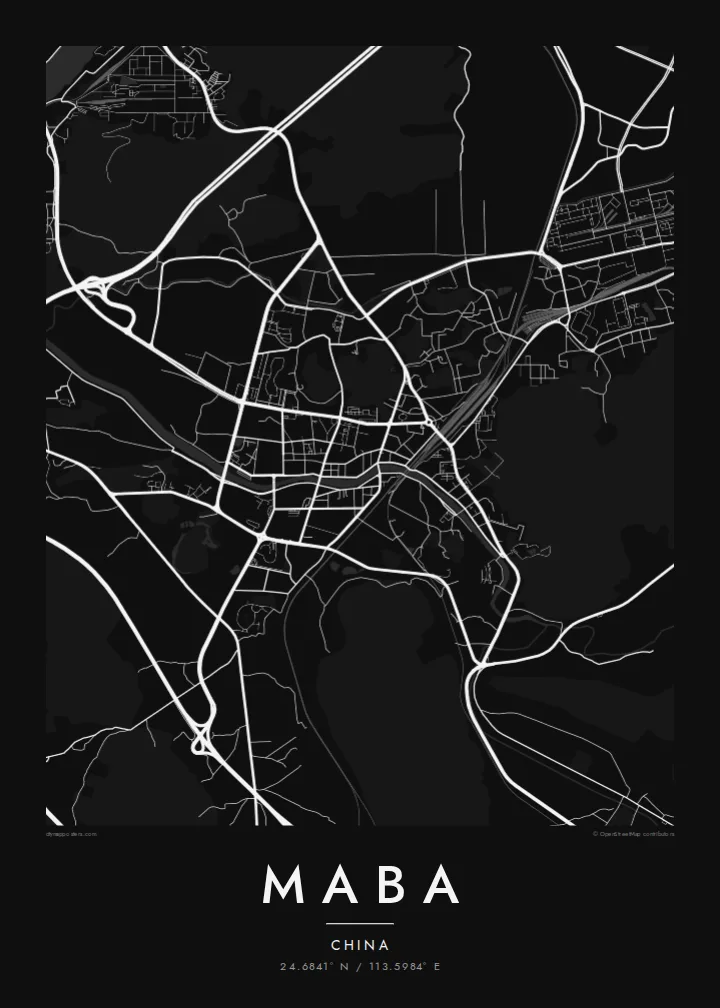
The town sits on lower ground surrounded by hills, so the streets gather along the valley floor while the edges of the map open into slopes and farmland.
Fakatino mape mukamuka · China
24.6841° N / 113.5984° E
A small Guangdong town between hills and farmland, its streets following a river valley in northern Guangdong



Taha e taone, lima e onoonoaga
Tapaki e taha puhala ke kitia ai ki luga he puipui. Kua tatai e totogi he tau puhala oti — pete he lolomi, poloka, po ke faila HD.
 Tau pikselo mooli · faila lolomi 24 × 36″
Maama mitaki ke lolomi
Ko e 100% e fahi mooli mai he faila lolomi. Ko e tau poster oti — pete kua lolomi, poloka, po ke utu hifo — kua taute ke he ha mautolu a tau tokoluga (server) ke he 300 DPI, hokotia ke he 7,200 × 10,800 piksela, ke maeke ai e tau ala ikiiki tote ke maaliali fakamitaki he lolomi 24 × 36″.
He Pā


Ko e mape
Maba is a town in the Qujiang area of Shaoguan, in the hilly north of Guangdong province. On a map it reads as a compact settlement in a valley, with streets drawn along the lower ground and green slopes rising around it. The town's roads connect to the wider network of northern Guangdong, and the countryside around it is a patchwork of fields, small villages and wooded hills.
Maba is known well beyond its size because of an archaeological discovery. In 1958 a partial human skull was found in a limestone cave near the town, and the fossil, known as Maba Man, became one of the notable early human finds in southern China. The limestone hills that held the cave are part of the same landscape that frames the town on the map.
Rather than a dense grid, Maba's street plan is irregular and practical, shaped by terrain and by older routes between villages. That gives a Maba map poster a looser, more organic texture: lanes that bend with the land, a few main roads carrying through traffic, and water and fields filling the spaces in between. It is a quiet subject that rewards a closer look.
The town sits on lower ground surrounded by hills, so the streets gather along the valley floor while the edges of the map open into slopes and farmland.
Karst hills in the area include the cave where the Maba Man fossil was found, linking the local landscape to one of southern China's known early human sites.
Lanes follow older routes and the lie of the land rather than a strict grid, giving the map an irregular, hand-drawn feel.
Taute ke ha hau
Lafi e aho, taha higoa po ke taha kupu haau, hiki e fakatino, lahi po ke tuaga.
Ko e kitiaaga nakai totogi kua tote e maaliali mo e fakamailoga vai. Ko e tau lolomi mo e tau faila HD kua taute ke he 300 DPI, hokotia ke he 7,200 × 10,800 px, nakai fai fakamailoga vai.
Ko e ha Maba
A map of Maba suits someone with family roots in Shaoguan, or a reader drawn to places where deep history sits under ordinary streets. Its loose pattern makes a gentle, understated piece for a bedroom or reading corner.
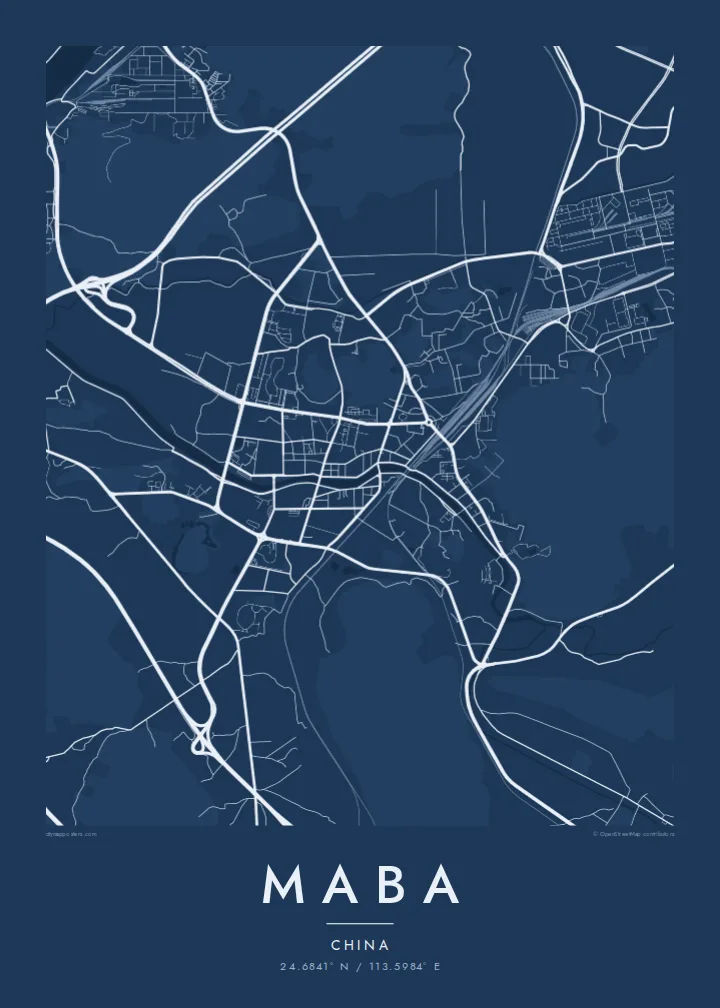
Personalise the title, add a subtitle with a name or year, and adjust the coordinates line. Choose from Classic black and white, Noir, Paper, Blueprint or Sand to match the room, whether you prefer a crisp print or a warmer tone.
Talaage e poster Maba| Lahi he lolomi | Maama | Tau faila |
|---|---|---|
| 30 × 40 cm11.8 × 15.7″ | 3,543 × 4,724 px | PNG · PDF |
| 29.7 × 42 cm (A3)11.7 × 16.5″ | 3,508 × 4,961 px | PNG · PDF |
| 42 × 59.4 cm (A2)16.5 × 23.4″ | 4,961 × 7,016 px | PNG · PDF |
| 45.7 × 61 cm18 × 24″ | 5,400 × 7,200 px | PNG · PDF |
| 50 × 70 cm19.7 × 27.6″ | 5,906 × 8,268 px | PNG · PDF |
| 61 × 91.4 cm24 × 36″ | 7,200 × 10,800 px | PNG · PDF |
Ke fakatatai, ko e fakatino noa kua 900 px e laulahi, fai fakamailoga mo e mo e tau mata komipiuta ni. Ko e tau faila HD kua ato hoko ke he 8× e maama ke he tau faahi takitaha mo e lolomi mitaki he lahi katoa he fakatino.
Fifili e taha puhala i luga he kupega, ti fifili e Poster Lolomi — e lahi mo e, kaeke ke manako ai koe, taha poloka — po ke Tau Faila HD Fakaeletonika. Ko e fakaotiaga totogi ko e taha gahua ni, ti ko e kupega he hau a talaaga ka fakafou fakahaga i mua he fakaotiaga e totogi.
Kua lolomi ai ke he pepa mitaki 200 gsm matte he taha he tau lahi ono, mai he 30 × 40 cm ke hoko ke he 24 × 36″. Kamata e tau poster lolomi mai he $39, kua putoia ai e utaaga.
E. Fifili e poloka akau malolō ke he lanu uli, tea, akau oki mooli, po ke akau pouli. Kua fakalataha mo e sioga malolō nakai malepe ti kua mautali ke tautau. Kamata e tau poster poloka mai he $99, kua putoia ai e utaaga.
Nakai totogi e fakafano ke he motu 60+. Ko e fakatino taha kua lolomi he fenoga lolomi ha mautolu kua tata mo e tau motu 30+, kua hoko mai he tau aho gahua 3–7. Maeke ia koe ke kikite e tuaga mo e fakamuitua he lalo he Haku Tau Fakatonu. Ke he falu motu kua 2–5 e tau tapu, ti ka nakai fakafano a mautolu ki ai, to fakaha he api tupe ia ki mua he totogi.
Fakafano mai e taha ata ki a mautolu he loto he 14 e tau aho tali mai he hokoaga, ti to lolomi foki e mautolu nakai totogi po ke liu atu e totogi ki a koe.
E. He editor i luga he kupega nei, hikihiki e matakupu, e matakupu lalo mo e laini coordinates ke he taha mena kua manako a koe ki ai, ti fifili e puhala mo e lahi. Ko e tau talaaga lolomi, poloka mo e fakaeletonika oti kua fakaaoga tonu e hau a fakatino.
Ma e $9 ka moua e koe e tau faila PNG 300 DPI mo e PDF kua mautali ke lolomi he tau lahi ono oti, nakai fai fakamailoga vai, ke lolomi i fe mena. Nakai maopoopo agaia? Utu hifo fakamua e kitiaaga nakai totogi ne fai fakamailoga vai.
Tata mai
