Johana old town
Narrow streets on rising ground around Zentoku-ji form the historic core. Their tight, regular pattern stands out sharply against the open fields around the town.
Fakatino mape mukamuka · Japan
36.5127° N / 136.8935° E
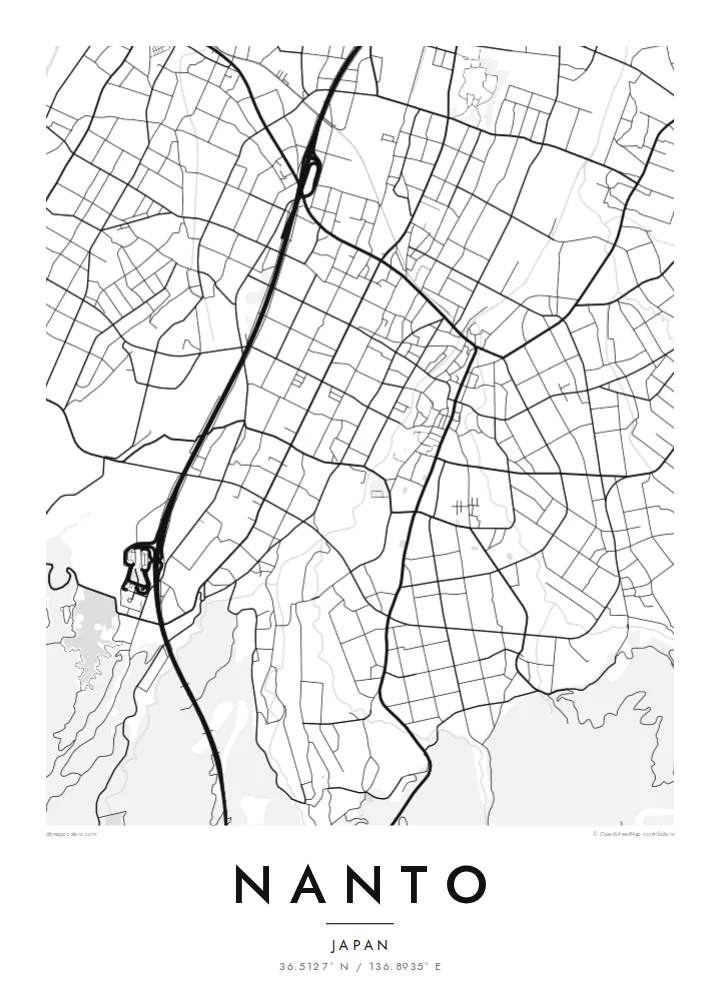
Johana's temple-town streets and the craft districts of central Nanto, set where the Toyama plain meets the mountains.


Taha e taone, lima e onoonoaga
Tapaki e taha puhala ke kitia ai ki luga he puipui. Kua tatai e totogi he tau puhala oti — pete he lolomi, poloka, po ke faila HD.
 Tau pikselo mooli · faila lolomi 24 × 36″
Maama mitaki ke lolomi
Ko e 100% e fahi mooli mai he faila lolomi. Ko e tau poster oti — pete kua lolomi, poloka, po ke utu hifo — kua taute ke he ha mautolu a tau tokoluga (server) ke he 300 DPI, hokotia ke he 7,200 × 10,800 piksela, ke maeke ai e tau ala ikiiki tote ke maaliali fakamitaki he lolomi 24 × 36″.
He Pā


Ko e mape
This map centres on the southern districts of Nanto, around the old town of Johana, where the Tonami plain narrows and meets the first ridges of the mountains. Johana grew as a temple town around Zentoku-ji, a large temple of the Jodo Shinshu school. Its centre is a tight grid of narrow streets lined with merchant houses, laid out on rising ground above the river.
Johana is known for its Hikiyama festival each spring, when ornate floats are pulled through the old streets. It is one of the Yama, Hoko, Yatai float festivals that UNESCO lists as intangible cultural heritage. Nearby Inami, also part of Nanto, has a long woodcarving tradition linked to the great Zuisen-ji temple.
A Nanto map poster centred on these districts shows a compact historic centre with small, walkable blocks, surrounded by paddies and the scattered farmsteads of the plain, with forested slopes rising to the south. It is a quieter, more intimate view than a map of the whole city, closer to the scale at which people actually live in Nanto.
Narrow streets on rising ground around Zentoku-ji form the historic core. Their tight, regular pattern stands out sharply against the open fields around the town.
The approach to Zuisen-ji in Inami is lined with woodcarvers' workshops. The craft grew up around the temple's rebuilding and still defines the district.
South of the town, the flat paddies give way to wooded ridges and river valleys, which add a denser, darker texture to the lower edge of the map.
Taute ke ha hau
Lafi e aho, taha higoa po ke taha kupu haau, hiki e fakatino, lahi po ke tuaga.
Ko e kitiaaga nakai totogi kua tote e maaliali mo e fakamailoga vai. Ko e tau lolomi mo e tau faila HD kua taute ke he 300 DPI, hokotia ke he 7,200 × 10,800 px, nakai fai fakamailoga vai.
Ko e ha Nanto
Travellers who come for the festival, a woodcarving workshop or a trip to Gokayama often pass through these towns, where families have lived for centuries. This map is a precise keepsake of a small Japanese townscape and suits a calm, minimal interior.
Add a title such as Johana or Inami, a subtitle with a date, and the coordinates line. Choose Classic black & white, Noir, Paper, Blueprint or Sand, then download all six print sizes or order a matte print with an optional wooden frame.
Talaage e poster Nanto| Lahi he lolomi | Maama | Tau faila |
|---|---|---|
| 30 × 40 cm11.8 × 15.7″ | 3,543 × 4,724 px | PNG · PDF |
| 29.7 × 42 cm (A3)11.7 × 16.5″ | 3,508 × 4,961 px | PNG · PDF |
| 42 × 59.4 cm (A2)16.5 × 23.4″ | 4,961 × 7,016 px | PNG · PDF |
| 45.7 × 61 cm18 × 24″ | 5,400 × 7,200 px | PNG · PDF |
| 50 × 70 cm19.7 × 27.6″ | 5,906 × 8,268 px | PNG · PDF |
| 61 × 91.4 cm24 × 36″ | 7,200 × 10,800 px | PNG · PDF |
Ke fakatatai, ko e fakatino noa kua 900 px e laulahi, fai fakamailoga mo e mo e tau mata komipiuta ni. Ko e tau faila HD kua ato hoko ke he 8× e maama ke he tau faahi takitaha mo e lolomi mitaki he lahi katoa he fakatino.
Fifili e taha puhala i luga he kupega, ti fifili e Poster Lolomi — e lahi mo e, kaeke ke manako ai koe, taha poloka — po ke Tau Faila HD Fakaeletonika. Ko e fakaotiaga totogi ko e taha gahua ni, ti ko e kupega he hau a talaaga ka fakafou fakahaga i mua he fakaotiaga e totogi.
Kua lolomi ai ke he pepa mitaki 200 gsm matte he taha he tau lahi ono, mai he 30 × 40 cm ke hoko ke he 24 × 36″. Kamata e tau poster lolomi mai he $39, kua putoia ai e utaaga.
E. Fifili e poloka akau malolō ke he lanu uli, tea, akau oki mooli, po ke akau pouli. Kua fakalataha mo e sioga malolō nakai malepe ti kua mautali ke tautau. Kamata e tau poster poloka mai he $99, kua putoia ai e utaaga.
Nakai totogi e fakafano ke he motu 60+. Ko e fakatino taha kua lolomi he fenoga lolomi ha mautolu kua tata mo e tau motu 30+, kua hoko mai he tau aho gahua 3–7. Maeke ia koe ke kikite e tuaga mo e fakamuitua he lalo he Haku Tau Fakatonu. Ke he falu motu kua 2–5 e tau tapu, ti ka nakai fakafano a mautolu ki ai, to fakaha he api tupe ia ki mua he totogi.
Fakafano mai e taha ata ki a mautolu he loto he 14 e tau aho tali mai he hokoaga, ti to lolomi foki e mautolu nakai totogi po ke liu atu e totogi ki a koe.
E. He editor i luga he kupega nei, hikihiki e matakupu, e matakupu lalo mo e laini coordinates ke he taha mena kua manako a koe ki ai, ti fifili e puhala mo e lahi. Ko e tau talaaga lolomi, poloka mo e fakaeletonika oti kua fakaaoga tonu e hau a fakatino.
Ma e $9 ka moua e koe e tau faila PNG 300 DPI mo e PDF kua mautali ke lolomi he tau lahi ono oti, nakai fai fakamailoga vai, ke lolomi i fe mena. Nakai maopoopo agaia? Utu hifo fakamua e kitiaaga nakai totogi ne fai fakamailoga vai.
Tata mai
