The Ganges
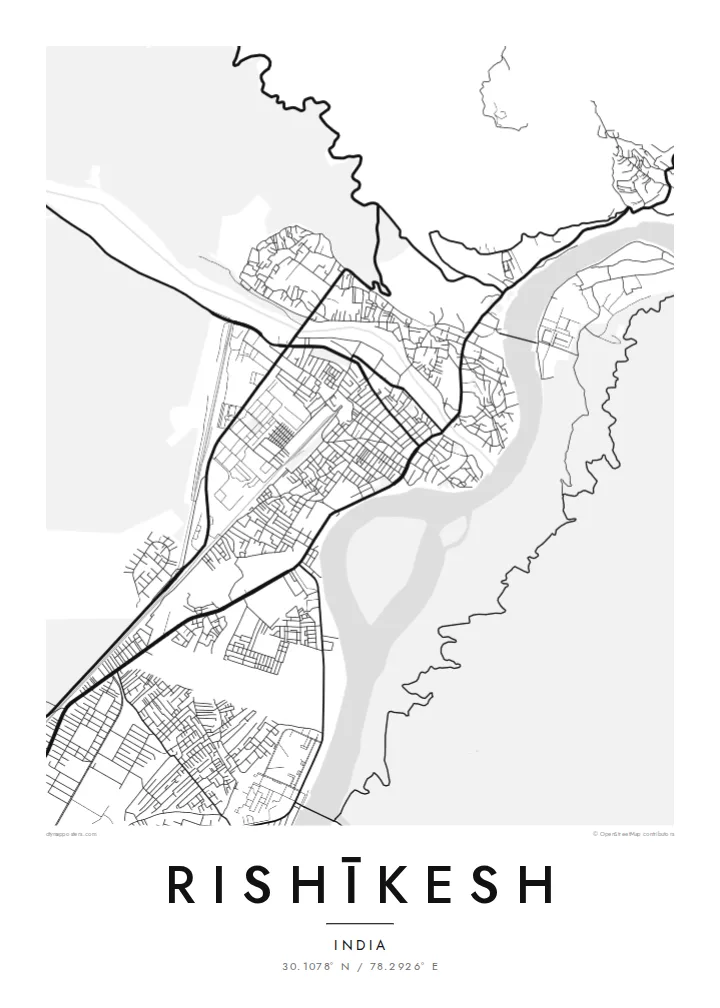
The river sweeps through the town in a broad curve, fresh from the mountains. It takes up much of the poster and divides it into two banks.
Fakatino mape mukamuka · India
30.1078° N / 78.2926° E
A town where the Ganges leaves the Himalayan foothills, its ashrams and bridges lining both banks


Taha e taone, lima e onoonoaga
Tapaki e taha puhala ke kitia ai ki luga he puipui. Kua tatai e totogi he tau puhala oti — pete he lolomi, poloka, po ke faila HD.
 Tau pikselo mooli · faila lolomi 24 × 36″
Maama mitaki ke lolomi
Ko e 100% e fahi mooli mai he faila lolomi. Ko e tau poster oti — pete kua lolomi, poloka, po ke utu hifo — kua taute ke he ha mautolu a tau tokoluga (server) ke he 300 DPI, hokotia ke he 7,200 × 10,800 piksela, ke maeke ai e tau ala ikiiki tote ke maaliali fakamitaki he lolomi 24 × 36″.
He Pā


Ko e mape
Rishikesh sits in Uttarakhand at the point where the Ganges comes out of the Himalayan foothills and begins its long journey across the plains. The map is built around the river: a broad, curving band of water with the town on its west bank and ashrams, lanes and temples on the east. Forested hills rise steeply on both sides and limit where streets can go.
Two suspension bridges, Ram Jhula and Lakshman Jhula, have long been the town's best-known crossings, and they show on the map as thin lines across the water. On each bank a network of narrow lanes leads down to the ghats. Further south, the town opens into more regular streets toward the railway and the road to Haridwar.
Rishikesh is known worldwide as a centre of yoga and meditation, and in 1968 the Beatles stayed at the Maharishi Mahesh Yogi ashram here. A Rishīkesh map poster shows the town's real structure: a river, a few bridges, and settlements pressed between water and hills, for anyone who has spent time on its banks.
The river sweeps through the town in a broad curve, fresh from the mountains. It takes up much of the poster and divides it into two banks.
Two pedestrian suspension bridges cross the river. On the map they are delicate lines connecting ashram districts on each side.
Steep, forested slopes close in on the town. Streets stop where the hills begin, giving the map a clear boundary.
Taute ke ha hau
Lafi e aho, taha higoa po ke taha kupu haau, hiki e fakatino, lahi po ke tuaga.
Ko e kitiaaga nakai totogi kua tote e maaliali mo e fakamailoga vai. Ko e tau lolomi mo e tau faila HD kua taute ke he 300 DPI, hokotia ke he 7,200 × 10,800 px, nakai fai fakamailoga vai.
Ko e ha Rishīkesh
Rishikesh is a place people go for a reason, for yoga training, a retreat or a pilgrimage. A map of the river and its bridges is a calm reminder of that time.
You can add your own title and subtitle, such as the dates of a stay or the name of an ashram, and edit the coordinates line. Choose from five styles: Classic black and white, Noir, Paper, Blueprint or Sand.
Talaage e poster Rishīkesh| Lahi he lolomi | Maama | Tau faila |
|---|---|---|
| 30 × 40 cm11.8 × 15.7″ | 3,543 × 4,724 px | PNG · PDF |
| 29.7 × 42 cm (A3)11.7 × 16.5″ | 3,508 × 4,961 px | PNG · PDF |
| 42 × 59.4 cm (A2)16.5 × 23.4″ | 4,961 × 7,016 px | PNG · PDF |
| 45.7 × 61 cm18 × 24″ | 5,400 × 7,200 px | PNG · PDF |
| 50 × 70 cm19.7 × 27.6″ | 5,906 × 8,268 px | PNG · PDF |
| 61 × 91.4 cm24 × 36″ | 7,200 × 10,800 px | PNG · PDF |
Ke fakatatai, ko e fakatino noa kua 900 px e laulahi, fai fakamailoga mo e mo e tau mata komipiuta ni. Ko e tau faila HD kua ato hoko ke he 8× e maama ke he tau faahi takitaha mo e lolomi mitaki he lahi katoa he fakatino.
Fifili e taha puhala i luga he kupega, ti fifili e Poster Lolomi — e lahi mo e, kaeke ke manako ai koe, taha poloka — po ke Tau Faila HD Fakaeletonika. Ko e fakaotiaga totogi ko e taha gahua ni, ti ko e kupega he hau a talaaga ka fakafou fakahaga i mua he fakaotiaga e totogi.
Kua lolomi ai ke he pepa mitaki 200 gsm matte he taha he tau lahi ono, mai he 30 × 40 cm ke hoko ke he 24 × 36″. Kamata e tau poster lolomi mai he $39, kua putoia ai e utaaga.
E. Fifili e poloka akau malolō ke he lanu uli, tea, akau oki mooli, po ke akau pouli. Kua fakalataha mo e sioga malolō nakai malepe ti kua mautali ke tautau. Kamata e tau poster poloka mai he $99, kua putoia ai e utaaga.
Ko e uta ke he lalolagi oti ha fai totogi. Ko e tā e poster taha he tupe ofi mahaki he falu kapitiga tā ha mautolu he motu 30+, ti kua hoko mai he tokai 3–7 e aho gahua. Maeke ia koe ke kikite e tutūaga mo e hukui he lalo ke he Tau Fakatonuaga haku. Falu motu kua fai 2–5 e faahi, ti ka nakai uta ni a mautolu ki ai, ka talahau atu he nofoaga i mua he totogi.
Fakafano mai e taha ata ki a mautolu he loto he 14 e tau aho tali mai he hokoaga, ti to lolomi foki e mautolu nakai totogi po ke liu atu e totogi ki a koe.
E. He editor i luga he kupega nei, hikihiki e matakupu, e matakupu lalo mo e laini coordinates ke he taha mena kua manako a koe ki ai, ti fifili e puhala mo e lahi. Ko e tau talaaga lolomi, poloka mo e fakaeletonika oti kua fakaaoga tonu e hau a fakatino.
Ma e $9 ka moua e koe e tau faila PNG 300 DPI mo e PDF kua mautali ke lolomi he tau lahi ono oti, nakai fai fakamailoga vai, ke lolomi i fe mena. Nakai maopoopo agaia? Utu hifo fakamua e kitiaaga nakai totogi ne fai fakamailoga vai.
Tata mai
