Westward corridors
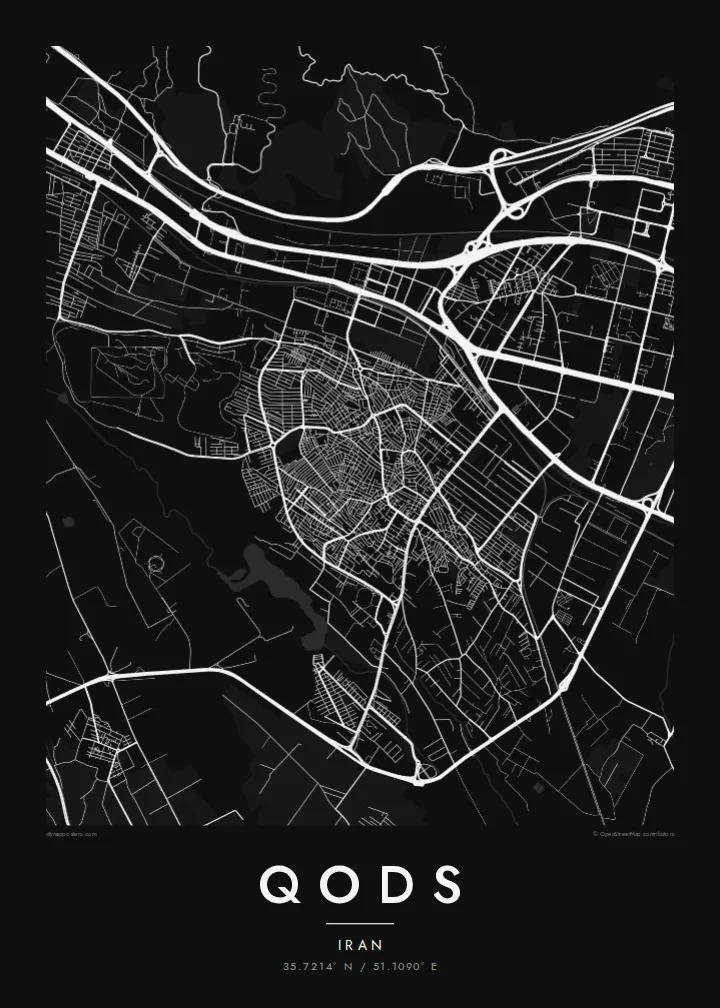
Major roads linking Tehran and Karaj pass along the city, and on the map they read as long, confident lines that anchor the whole composition.
Positala ya mapu yosavuta · Iran
35.7214° N / 51.1090° E
A dense grid of workshops and homes on the dry plain west of Tehran, crossed by highways running toward Karaj



Mzinda umodzi, mawonekedwe asanu
Khudzani sitayelo kuti muwone pa khoma. Masitayelo onse amawononga ndalama zofanana — zosindikizidwa, zokutidwa mu chimango kapena ngati mafayilo a HD.
 Ma pixel enieni · fayilo yosindikiza 24 × 36″
Yowala posindikiza
Awa ndi chithunzi 100% chodulidwa cha fayilo yeniyeni yosindikiza. Poster iliyonse — yosindikizidwa, yokutidwa mu chimango kapena yotsitsidwa — imapangidwa pa maseva athu pa 300 DPI, mpaka ma pixel 7,200 × 10,800, choncho ngakhale misewu yaying'ono kwambiri imakhalabe yowoneka bwino pa kope la 24 × 36″.
Pakhoma


Mapu
Qods sits on the flat, arid plain between Tehran and Karaj, where the capital's western edge turns into a separate city. From above it shows a tight street pattern of blocks and courtyards, broken up by wide arterial roads and the large rectangular plots of industrial zones. Its edges are hard to see on the map, because the city runs into its neighbours along the main traffic corridors.
The town grew quickly in the second half of the twentieth century from a small settlement once known as Qaleh Hasan Khan. Much of that growth came from Tehran's industrial spread westward, and the map still shows it: warehouses and factory compounds sit beside residential districts, with smaller lanes filling the space between the main roads. Nothing about the layout is decorative. It is plainly a working city.
A Qods map poster shows that practical geometry clearly. Printed in black and white, the long highways become strong horizontal strokes and the residential blocks turn into fine texture, with larger industrial parcels standing out as pale rectangles. The mountains to the north are left off the frame, so the composition stays on the city itself: a plain, well-organised street network on the high plateau.
Major roads linking Tehran and Karaj pass along the city, and on the map they read as long, confident lines that anchor the whole composition.
Large factory and warehouse plots appear as broad, quiet shapes among the finer residential streets, which gives the print a clear contrast in scale.
The residential districts are made of small blocks and narrow lanes, so parts of the city show up as dense, even hatching when printed.
Ipangeni yanu
Onjezani tsiku, dzina kapena mawu anu, sinthani mawonekedwe, kukula kapena momwe yaimira.
Chitsanzo chaulere ndi chotsika mu resolution ndipo chili ndi chizindikiro chothira madzi. Zosindikizidwa ndi mafayilo a HD zimapangidwa pa 300 DPI, mpaka ma px 7,200 × 10,800, popanda chizindikiro chothira madzi.
Chifukwa chiyani Qods
People who grew up in Qods, or who once worked in its factories and offices, often want a record of the place as it actually is rather than a postcard view. A street map gives them that, and a personalised title, date or coordinates line can tie it to a family home or a first job.
The design is available in five styles: Classic black & white, Noir, Paper, Blueprint and Sand. Blueprint suits the city's industrial character, and Paper gives it a softer look. The digital HD files cost $9, and printed posters on matte paper are shipped from partners in more than 30 countries.
Odara poster ya Qods| Kukula kosindikiza | Mphamvu ya chithunzi | Mafayilo |
|---|---|---|
| 30 × 40 cm11.8 × 15.7″ | 3,543 × 4,724 px | PNG · PDF |
| 29.7 × 42 cm (A3)11.7 × 16.5″ | 3,508 × 4,961 px | PNG · PDF |
| 42 × 59.4 cm (A2)16.5 × 23.4″ | 4,961 × 7,016 px | PNG · PDF |
| 45.7 × 61 cm18 × 24″ | 5,400 × 7,200 px | PNG · PDF |
| 50 × 70 cm19.7 × 27.6″ | 5,906 × 8,268 px | PNG · PDF |
| 61 × 91.4 cm24 × 36″ | 7,200 × 10,800 px | PNG · PDF |
Poyerekeza, chithunzi chaulere ndi cha 900 px m'lifupi, chili ndi chizindikiro ndipo ndi cha pa sikirini. Mafayilo a HD ali ndi mphamvu yochulukira mpaka 8× mbali iliyonse ndipo amasindikizika bwino pa kukula konse kwa positala.
Sankhani sitayelo kumtunda kwa tsamba, kenako musankhe Poster Yosindikizidwa — kukula ndi, mukafuna, chimango — kapena Mafayilo a Digital HD. Kulipira kumatenga sitepe imodzi, ndipo tsamba la oda yanu limasinthidwa nthawi yomweyo pambuyo pa kulipira.
Imasindikizidwa pa pepala labwino la matte la 200 gsm mu kukula kumodzi mwa zisanu ndi chimodzi, kuyambira 30 × 40 cm mpaka 24 × 36″. Maposita osindikizidwa amayamba pa $39, kutumiza kuphatikizidwa.
Inde. Sankhani chimango cha mtengo wolimba mu utoto wakuda, woyera, oak wachilengedwe kapena mtengo wakuda. Chimabwera ndi galasi losathyoka ndipo chikonzekera kupachikidwa nthawi yomweyo. Maposita a mu chimango amayamba pa $99, kutumiza kuphatikizidwa.
Kutumiza ndi kwaulere kumayiko oposa 60. Positala iliyonse imasindikizidwa ndi mnzathu wosindikiza wapafupi kwambiri mwa anzathu m'mayiko oposa 30, ndipo nthawi zambiri imafika m'masiku 3–7 antchito. Mukhoza kutsatira momwe oda ilili ndi malo ake pa "Maoda Anga". Mayiko ena amatenga masabata 2–5, ndipo kumene sitinayambe kutumiza, tsambali likuuzani musanalipire.
Titumizireni chithunzi masiku 14 kuchokera pa tsiku la kutumiza ndipo tidzaisindikizanso kwaulere kapena kukubwezerani ndalama zanu.
Inde. Mu chida chokonzera pa tsambali, sinthani mutu, mutu wowonjezera ndi mzere wa ma coordinates kukhala chilichonse chomwe mufuna, ndipo sankhani sitayelo ndi kukula. Maoda osindikizidwa, a mu chimango ndi a digital onse amagwiritsa ntchito kapangidwe kanu enieni.
Pa $9 mumalandira mafayilo a PNG a 300 DPI ndi PDF okonzeka kusindikiza mu kukula konse kwa zisanu ndi chimodzi, popanda chizindikiro chothira madzi, kuti musindikize kulikonse. Simunatsimikize? Tsitsani kaye chitsanzo chaulere chokhala ndi chizindikiro chothira madzi.
