Coastal strip
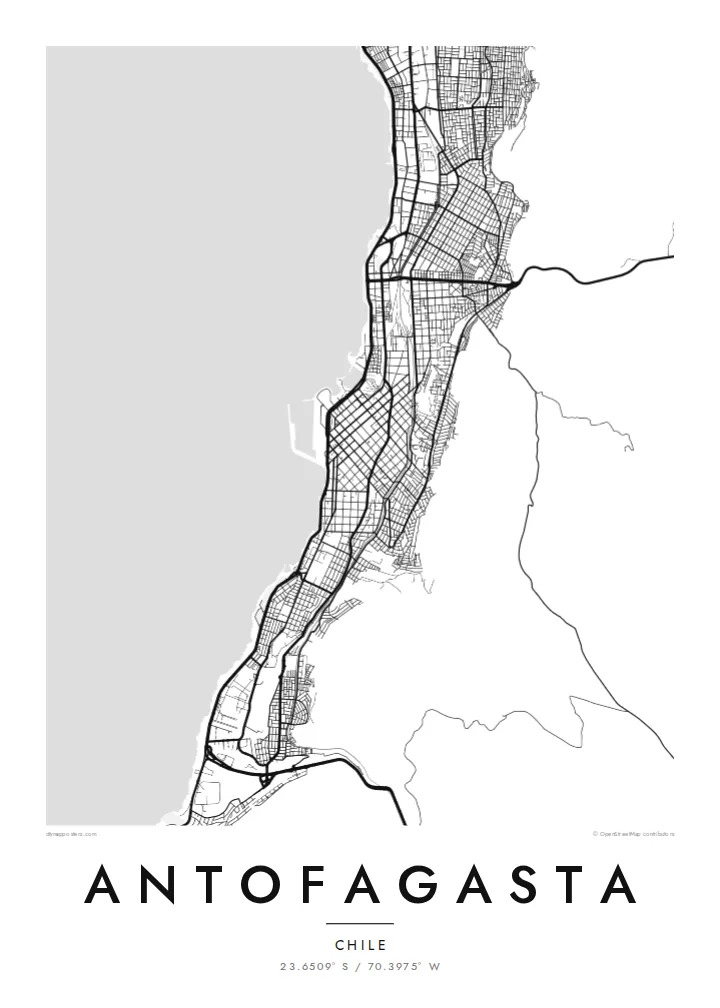
The city's streets form a long, thin band parallel to the ocean, rarely more than a few kilometres deep, giving the poster an unusually elongated urban shape.
Posta faʻafanua faigofie · Chile
23.6509° S / 70.3975° W
A long, narrow port city stretched along the Pacific, pressed against the steep coastal range at the edge of the Atacama.


Tasi le aai, lagona e lima
Tapi se sitaili e vaai ai i luga o le puipui. E tutusa uma le tau o sitaili — pe lolomiina, faapipiiina, pe avea ma faila HD.
 Pika Moni · Faila Lolomi 24 × 36″
Manino mo le lolomi
O se vaega atoa (100%) lenei mai le faila lolomi moni. O posita uma — pe lolomiina, faapipiiina pe download mai — e faia i luga o a matou server i le 300 DPI, e oo atu i le 7,200 × 10,800 pika, ina ia manino pea auala laiti i luga o se lolomiga 24 × 36″.
I luga o le puipui


Le faʻafanua
Antofagasta is one of the most linear cities in South America. It runs for many kilometres along the Pacific in northern Chile, yet in most places it is only a few kilometres wide, hemmed in by the steep slopes of the coastal cordillera. On a map it appears as a thin band of streets between an unbroken ocean edge and bare desert hills.
The city grew in the nineteenth century as a port for nitrate and silver, and today it serves Chile's great copper mines in the Atacama Desert, one of the driest places on earth. Just north of the city, the sea has carved La Portada, a natural rock arch standing offshore, now protected as a natural monument.
An Antofagasta map poster captures this extreme shape with great clarity. The coastline forms one continuous line, the street grid runs parallel to it in long rows, and the port breaks the shoreline near the centre. Behind everything, the empty desert slopes give the city a hard inland edge that makes the whole composition feel spare and precise.
The city's streets form a long, thin band parallel to the ocean, rarely more than a few kilometres deep, giving the poster an unusually elongated urban shape.
Near the historic centre, the port's breakwaters and piers interrupt the smooth coastline, marking the point where the city began as a mining export harbour.
Steep, dry hills rise directly behind the city, leaving the eastern side of the map almost empty and sharpening the contrast between built-up ground and desert.
Fai mo oe
Faʻaopoopo se aso, se igoa po o sau lava upu, sui le sitaili, lapoʻa po o le itu.
O le preview e leai se totogi e maualalo le resolution ma iai se watermark. O lolomi ma faila HD e faia i le 300 DPI, e oo atu i le 7,200 × 10,800 px, e aunoa ma se watermark.
Aisea Antofagasta
Antofagasta draws people from across Chile and beyond to work in mining and at the port, and many leave with a strong memory of its sea, its light and the desert behind it. A map of the city keeps that edge-of-the-world geography close.
Add a personal title, subtitle or coordinates line, for instance the name of a neighbourhood, a project or an arrival date. The poster is available in five styles, Classic black & white, Noir, Paper, Blueprint and Sand, as an instant HD download or a printed matte poster.
Faatau le posita Antofagasta| Lapoʻa lolomi | Manino | Faila |
|---|---|---|
| 30 × 40 cm11.8 × 15.7″ | 3,543 × 4,724 px | PNG · PDF |
| 29.7 × 42 cm (A3)11.7 × 16.5″ | 3,508 × 4,961 px | PNG · PDF |
| 42 × 59.4 cm (A2)16.5 × 23.4″ | 4,961 × 7,016 px | PNG · PDF |
| 45.7 × 61 cm18 × 24″ | 5,400 × 7,200 px | PNG · PDF |
| 50 × 70 cm19.7 × 27.6″ | 5,906 × 8,268 px | PNG · PDF |
| 61 × 91.4 cm24 × 36″ | 7,200 × 10,800 px | PNG · PDF |
Ae faʻatusatusa, o le faʻataʻitaʻiga e leai se totogi e 900 px le lautele, e iai le faʻailoga vai ma e mo mata. O faila HD e oʻo atu i le 8× le manino i itu taʻitasi ma e lolomi manino i le lapoʻa atoa o le posta.
Filifili se sitaili i le pito i luga o le itulau, ona filifili lea o le Posita Lolomi — se lapopoa ma, afai e te fiafia, se faavaa — po o Faila HD Numera. E na o le tasi laasaga o le Checkout, ma o le a fesuia'i lou itulau o oka i le taimi lava e mae'a ai le totogi.
E lolomiina i luga o pepa matte maualuga le tulaga e 200 gsm, i se tasi o lapopoa e ono, mai le 30 × 40 cm i le 24 × 36″. E amata le tau o posita lolomi mai le $39, aofia ai le auina atu.
Ioe. Filifili se faavaa laau malosi i le lanu uliuli, sina, oak masani, po o le laau pogisa. E aofia ai se tioata e le gau ma ua saunia e tautau i luga. E amata le tau o posita faavaa mai le $99, aofia ai le auina atu.
E leai se totogi o le auina atu i atunuu e 60+. O pepa ata taʻitasi e lolomiina e le tasi o matou paaga lolomi e latalata mai i atunuu e 30+, ma e masani ona taunuu i le 3–7 aso faigaluega. E mafai ona e mulimulitaia le tulaga ma le sailiga i lalo o My Orders. O nisi atunuu e 2–5 vaiaso, ma i nofoaga e lei matou auina atu iai, e taʻu atu e le saite ia te oe a o lei totogi.
Auina mai se ata i totonu o le 14 aso talu ona taunuu, ma o le a matou toe lolomiina e leai se totogi po o le toe faafoi atu lau tupe.
Ioe. I totonu o le editor i lenei itulau, suia le ulutala, le ulutala laititi ma le laina o coordinates i soo se mea e te fiafia i ai, ma filifili se sitaili ma le lapopoa. O oka lolomi, faavaa ma numera e faaaoga uma lava lau mamanu.
Mo le $9 e te maua ai faila PNG 300 DPI ma PDF ua saunia mo le lolomi i lapopoa uma e ono, e aunoa ma se watermark, e mafai ona lolomi i soo se mea. Le mautinoa lava? Download muamua se preview e leai se totogi ma le watermark.
Latalata ane
