The Loa River
Chile's longest river passes along Calama, and the narrow band of fields and trees on its banks is the reason a town could grow here in one of the driest deserts on earth.
Posta faʻafanua faigofie · Chile
22.4567° S / 68.9237° W
An oasis grid on the Loa River, ringed by open Atacama desert and the vast terraced pit of Chuquicamata to the north.


Tasi le aai, lagona e lima
Tapi se sitaili e vaai ai i luga o le puipui. E tutusa uma le tau o sitaili — pe lolomiina, faapipiiina, pe avea ma faila HD.
 Pika Moni · Faila Lolomi 24 × 36″
Manino mo le lolomi
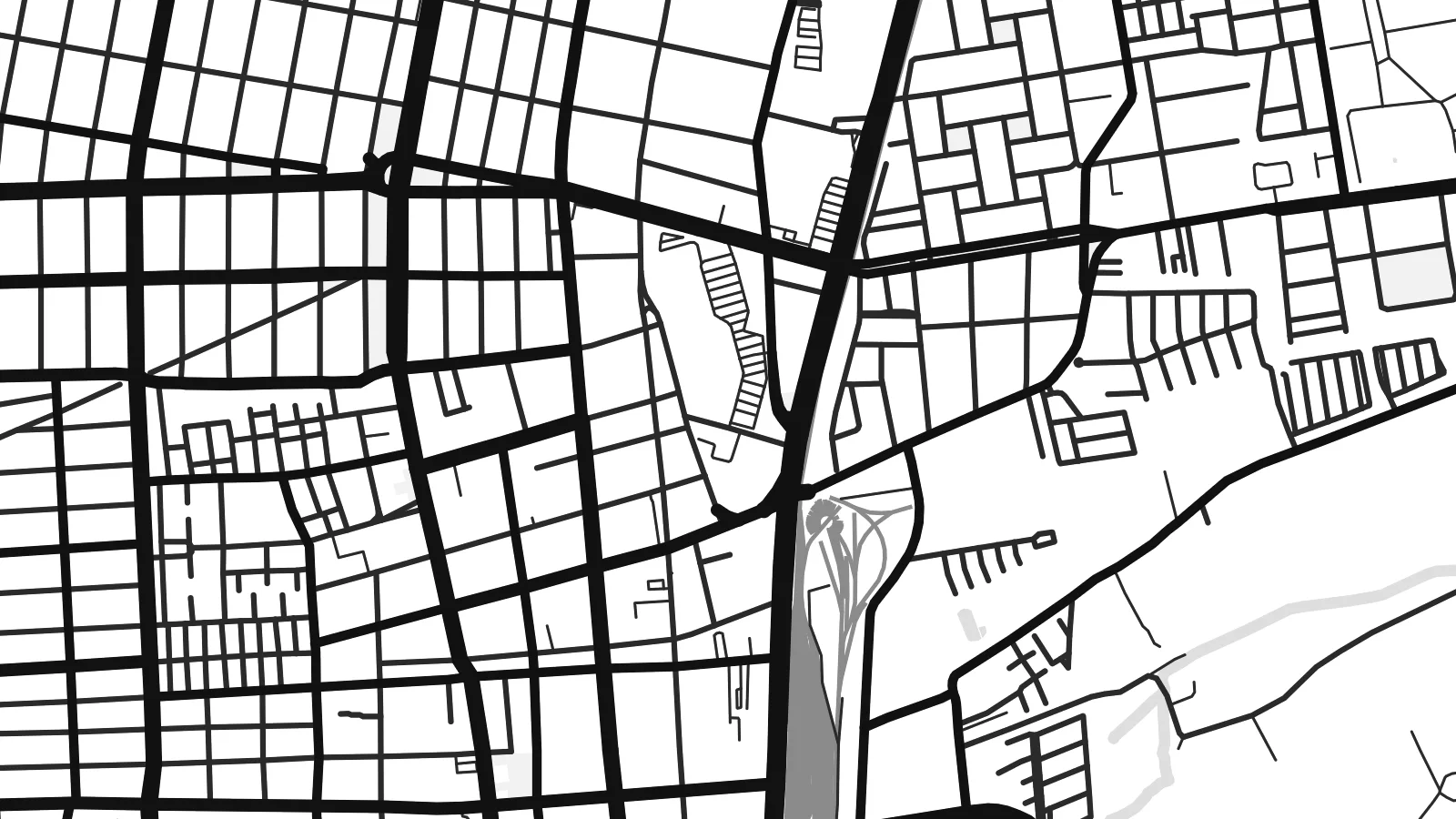
O se vaega atoa (100%) lenei mai le faila lolomi moni. O posita uma — pe lolomiina, faapipiiina pe download mai — e faia i luga o a matou server i le 300 DPI, e oo atu i le 7,200 × 10,800 pika, ina ia manino pea auala laiti i luga o se lolomiga 24 × 36″.
I luga o le puipui


Le faʻafanua
From above, Calama is a compact block of streets surrounded by bare desert. The Loa River, the longest in Chile, curves along the town's edge, and a thin strip of green follows its banks. Beyond that the map turns almost empty: dry plains, a few highways and the long lines of mining roads heading out into the high Atacama.
The city grew as the service centre for copper. A short distance north lies Chuquicamata, one of the largest open-pit copper mines in the world, and its stepped rings read on a map like a contour drawing cut into the ground. Calama is also the usual starting point for travellers going on to San Pedro de Atacama and the salt flats beyond.
A Calama map poster shows a city defined by contrast. Dense residential blocks and the airport runway sit on one side, open desert on the other, with the river as the single soft line running through. In black and white the empty ground becomes part of the design, giving the streets a sharp, almost architectural outline.
Chile's longest river passes along Calama, and the narrow band of fields and trees on its banks is the reason a town could grow here in one of the driest deserts on earth.
The huge open-pit copper mine sits a short drive north of the city. Its terraced walls form concentric rings that stand out clearly on any map of the area.
Past the last streets there is little but open ground and straight roads. That emptiness frames the city tightly and makes its street pattern easy to read at poster scale.
Fai mo oe
Faʻaopoopo se aso, se igoa po o sau lava upu, sui le sitaili, lapoʻa po o le itu.
O le preview e leai se totogi e maualalo le resolution ma iai se watermark. O lolomi ma faila HD e faia i le 300 DPI, e oo atu i le 7,200 × 10,800 px, e aunoa ma se watermark.
Aisea Calama
Calama is a place people come to for work, for the mines or on the way into the Atacama, and many keep a strong tie to it afterwards. A map poster keeps the street grid, the river and the surrounding desert in one clean image.
You can personalise the title, subtitle and coordinates line, for example with a year spent in the north or the name of a neighbourhood. Choose from five styles: Classic black & white, Noir, Paper, Blueprint or Sand, which suits the desert setting well.
Faatau le posita Calama| Lapoʻa lolomi | Manino | Faila |
|---|---|---|
| 30 × 40 cm (11.8 × 15.7″) | 3,543 × 4,724 px | PNG · PDF |
| 29.7 × 42 cm (A3, 11.7 × 16.5″) | 3,508 × 4,961 px | PNG · PDF |
| 42 × 59.4 cm (A2, 16.5 × 23.4″) | 4,961 × 7,016 px | PNG · PDF |
| 45.7 × 61 cm (18 × 24″) | 5,400 × 7,200 px | PNG · PDF |
| 50 × 70 cm (19.7 × 27.6″) | 5,906 × 8,268 px | PNG · PDF |
| 61 × 91.4 cm (24 × 36″) | 7,200 × 10,800 px | PNG · PDF |
Ae faʻatusatusa, o le faʻataʻitaʻiga e leai se totogi e 900 px le lautele, e iai le faʻailoga vai ma e mo mata. O faila HD e oʻo atu i le 8× le manino i itu taʻitasi ma e lolomi manino i le lapoʻa atoa o le posta.
Filifili se sitaili i le pito i luga o le itulau, ona filifili lea o le Posita Lolomi — se lapopoa ma, afai e te fiafia, se faavaa — po o Faila HD Numera. E na o le tasi laasaga o le Checkout, ma o le a fesuia'i lou itulau o oka i le taimi lava e mae'a ai le totogi.
E lolomiina i luga o pepa matte maualuga le tulaga e 200 gsm, i se tasi o lapopoa e ono, mai le 30 × 40 cm i le 24 × 36″. E amata le tau o posita lolomi mai le $39, aofia ai le auina atu.
Ioe. Filifili se faavaa laau malosi i le lanu uliuli, sina, oak masani, po o le laau pogisa. E aofia ai se tioata e le gau ma ua saunia e tautau i luga. E amata le tau o posita faavaa mai le $99, aofia ai le auina atu.
E leai se totogi mo le uta i le lalolagi atoa. O poster ta'itasi e lolomi e le paaga lolomi e latalata mai i matou i atunuu e 30+, ma e masani ona taunuu i aso faigaluega e 3–7. E mafai ona e mulimuli i le tulaga ma le tracking i le "Aʻu Oka". O nisi atunuu e 2–5 vaiaso, ma i atunuu matou te lei tuuina atu ai, e taʻu atu e le saite iā te oe ae e te leʻi totogiina.
Auina mai se ata i totonu o le 14 aso talu ona taunuu, ma o le a matou toe lolomiina e leai se totogi po o le toe faafoi atu lau tupe.
Ioe. I totonu o le editor i lenei itulau, suia le ulutala, le ulutala laititi ma le laina o coordinates i soo se mea e te fiafia i ai, ma filifili se sitaili ma le lapopoa. O oka lolomi, faavaa ma numera e faaaoga uma lava lau mamanu.
Mo le $9 e te maua ai faila PNG 300 DPI ma PDF ua saunia mo le lolomi i lapopoa uma e ono, e aunoa ma se watermark, e mafai ona lolomi i soo se mea. Le mautinoa lava? Download muamua se preview e leai se totogi ma le watermark.
