Plaza 9 de Julio
The main square sits at the centre of the colonial grid, a single open block surrounded by the cathedral, the Cabildo and arcaded streets leading out in four directions.
Posta faʻafanua faigofie · Argentina
24.8065° S / 65.4200° W
A colonial grid in Argentina's Lerma Valley, laid out from a central plaza, with a hill rising on its eastern edge.



Tasi le aai, lagona e lima
Tapi se sitaili e vaai ai i luga o le puipui. E tutusa uma le tau o sitaili — pe lolomiina, faapipiiina, pe avea ma faila HD.
 Pika Moni · Faila Lolomi 24 × 36″
Manino mo le lolomi
O se vaega atoa (100%) lenei mai le faila lolomi moni. O posita uma — pe lolomiina, faapipiiina pe download mai — e faia i luga o a matou server i le 300 DPI, e oo atu i le 7,200 × 10,800 pika, ina ia manino pea auala laiti i luga o se lolomiga 24 × 36″.
I luga o le puipui


Le faʻafanua
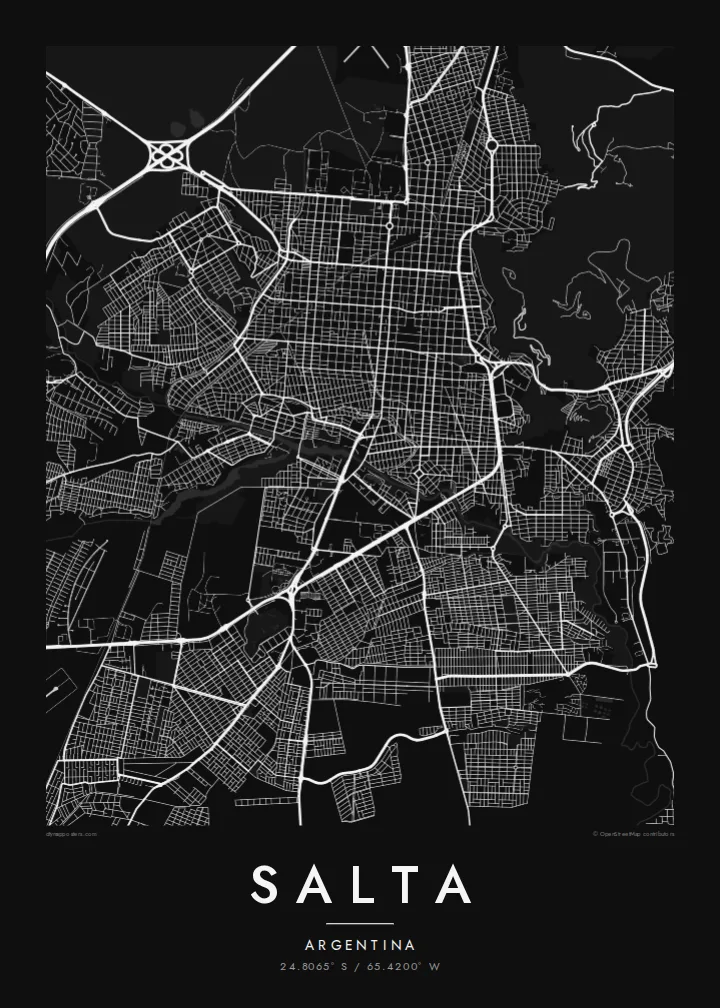
Salta was founded in 1582 in the Lerma Valley, a green basin in the foothills of the Andes in northwest Argentina. The Spanish plan is still clear on the map: a chessboard of square blocks around Plaza 9 de Julio, where the cathedral and the colonial Cabildo face each other across the square. The grid extends in every direction with remarkable consistency.
On the eastern edge, Cerro San Bernardo rises abruptly above the city, and a cable car climbs to the top from a park at its foot. The street pattern stops where the slope begins. To the south, the Arenales River crosses the valley, and newer neighbourhoods spread north and west along wide avenues toward the surrounding farmland.
Salta is often called Salta la Linda, and it is a common starting point for trips into the Andean valleys and the high puna, including the Train to the Clouds. A Salta map poster focuses on the city itself: a disciplined grid, a hill that interrupts it and a valley opening out beyond.
The main square sits at the centre of the colonial grid, a single open block surrounded by the cathedral, the Cabildo and arcaded streets leading out in four directions.
The hill rises sharply on the city's eastern side. Its wooded slopes break the grid and give the composition a strong natural edge.
Regular square blocks extend from the centre in every direction, a textbook Spanish colonial plan that makes a striking pattern in black and white.
Fai mo oe
Faʻaopoopo se aso, se igoa po o sau lava upu, sui le sitaili, lapoʻa po o le itu.
O le preview e leai se totogi e maualalo le resolution ma iai se watermark. O lolomi ma faila HD e faia i le 300 DPI, e oo atu i le 7,200 × 10,800 px, e aunoa ma se watermark.
Aisea Salta
Travellers heading north into the Andes often remember Salta as the calm, handsome city at the start of the road. For Salteños it is simply home, and most of them could find their way around the grid by the plaza without looking.
Write your own title and subtitle, perhaps a travel date or a family name, and keep or change the coordinates line. Choose Classic black & white, Noir, Paper, Blueprint or Sand, then take the $9 HD files or a printed poster with an optional wooden frame.
Faatau le posita Salta| Lapoʻa lolomi | Manino | Faila |
|---|---|---|
| 30 × 40 cm (11.8 × 15.7″) | 3,543 × 4,724 px | PNG · PDF |
| 29.7 × 42 cm (A3, 11.7 × 16.5″) | 3,508 × 4,961 px | PNG · PDF |
| 42 × 59.4 cm (A2, 16.5 × 23.4″) | 4,961 × 7,016 px | PNG · PDF |
| 45.7 × 61 cm (18 × 24″) | 5,400 × 7,200 px | PNG · PDF |
| 50 × 70 cm (19.7 × 27.6″) | 5,906 × 8,268 px | PNG · PDF |
| 61 × 91.4 cm (24 × 36″) | 7,200 × 10,800 px | PNG · PDF |
Ae faʻatusatusa, o le faʻataʻitaʻiga e leai se totogi e 900 px le lautele, e iai le faʻailoga vai ma e mo mata. O faila HD e oʻo atu i le 8× le manino i itu taʻitasi ma e lolomi manino i le lapoʻa atoa o le posta.
Filifili se sitaili i le pito i luga o le itulau, ona filifili lea o le Posita Lolomi — se lapopoa ma, afai e te fiafia, se faavaa — po o Faila HD Numera. E na o le tasi laasaga o le Checkout, ma o le a fesuia'i lou itulau o oka i le taimi lava e mae'a ai le totogi.
E lolomiina i luga o pepa matte maualuga le tulaga e 200 gsm, i se tasi o lapopoa e ono, mai le 30 × 40 cm i le 24 × 36″. E amata le tau o posita lolomi mai le $39, aofia ai le auina atu.
Ioe. Filifili se faavaa laau malosi i le lanu uliuli, sina, oak masani, po o le laau pogisa. E aofia ai se tioata e le gau ma ua saunia e tautau i luga. E amata le tau o posita faavaa mai le $99, aofia ai le auina atu.
E leai se totogi mo le uta i le lalolagi atoa. O poster ta'itasi e lolomi e le paaga lolomi e latalata mai i matou i atunuu e 30+, ma e masani ona taunuu i aso faigaluega e 3–7. E mafai ona e mulimuli i le tulaga ma le tracking i le "Aʻu Oka". O nisi atunuu e 2–5 vaiaso, ma i atunuu matou te lei tuuina atu ai, e taʻu atu e le saite iā te oe ae e te leʻi totogiina.
Auina mai se ata i totonu o le 14 aso talu ona taunuu, ma o le a matou toe lolomiina e leai se totogi po o le toe faafoi atu lau tupe.
Ioe. I totonu o le editor i lenei itulau, suia le ulutala, le ulutala laititi ma le laina o coordinates i soo se mea e te fiafia i ai, ma filifili se sitaili ma le lapopoa. O oka lolomi, faavaa ma numera e faaaoga uma lava lau mamanu.
Mo le $9 e te maua ai faila PNG 300 DPI ma PDF ua saunia mo le lolomi i lapopoa uma e ono, e aunoa ma se watermark, e mafai ona lolomi i soo se mea. Le mautinoa lava? Download muamua se preview e leai se totogi ma le watermark.
