Central junction
The main roads come together at the town centre, where the street network is densest. Most of the other routes on the poster branch out from this point.
Posta faʻafanua faigofie · Uganda
0.1340° S / 30.4962° E
A hill town in western Uganda, where roads follow the ridges and farmland fills the valleys between them


Tasi le aai, lagona e lima
Tapi se sitaili e vaai ai i luga o le puipui. E tutusa uma le tau o sitaili — pe lolomiina, faapipiiina, pe avea ma faila HD.
 Pika Moni · Faila Lolomi 24 × 36″
Manino mo le lolomi
O se vaega atoa (100%) lenei mai le faila lolomi moni. O posita uma — pe lolomiina, faapipiiina pe download mai — e faia i luga o a matou server i le 300 DPI, e oo atu i le 7,200 × 10,800 pika, ina ia manino pea auala laiti i luga o se lolomiga 24 × 36″.
I luga o le puipui


Le faʻafanua
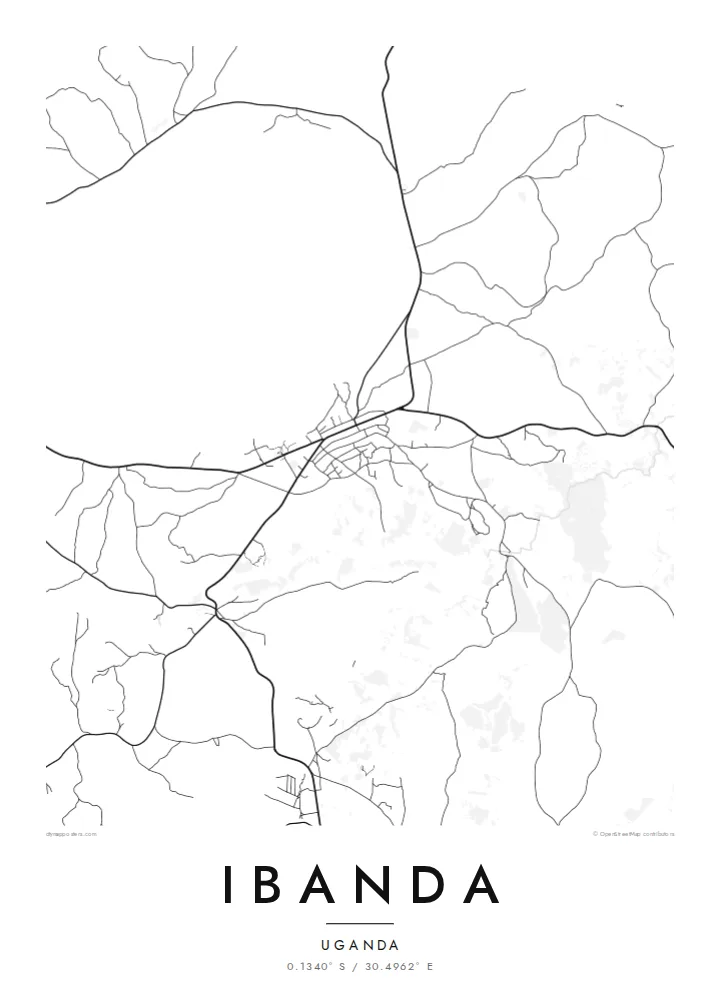
Ibanda is in western Uganda, in hilly country north of Mbarara. On a map the town looks loose and organic. There is a small commercial core where the main roads meet, and from there tracks and streets spread out along the ridges and down into the valleys. The land around is broken up by farm plots, so the edge of the built-up area is soft and hard to pin down.
The terrain shapes almost everything. Roads tend to follow contours rather than a grid, and housing gathers along the routes that link the town to nearby trading centres. Between the ridges, the lower ground is mostly cultivated. This region of Uganda is known for bananas and cattle keeping, and the farmland can be seen right up to the outer streets.
An Ibanda map poster shows that relationship between settlement and land. The streets make a fine, branching network, closer together near the centre and thinning out towards the hills. It is not a formal plan, and the pattern it forms looks natural, a little like the veins of a leaf spreading out from one stem.
The main roads come together at the town centre, where the street network is densest. Most of the other routes on the poster branch out from this point.
Many roads run along the tops of the hills and follow the curves of the land. On the map they show up as long, gently bending lines instead of straight segments.
Cultivated land comes right up to the town, so the outer streets break up into scattered tracks. This gives the map a soft, feathered edge.
Fai mo oe
Faʻaopoopo se aso, se igoa po o sau lava upu, sui le sitaili, lapoʻa po o le itu.
O le preview e leai se totogi e maualalo le resolution ma iai se watermark. O lolomi ma faila HD e faia i le 300 DPI, e oo atu i le 7,200 × 10,800 px, e aunoa ma se watermark.
Aisea Ibanda
An Ibanda map is a personal thing to own. It suits someone who grew up there, has family in the hills around the town or once worked in western Uganda and wants a quiet reminder of the place on the wall.
You can set the title, subtitle and coordinates line yourself, and pick one of five styles: Classic black and white, Noir, Paper, Blueprint or Sand. There is a free watermarked preview. Full HD files cost $9, and printed posters are shipped from partners in more than 30 countries.
Faatau le posita Ibanda| Lapoʻa lolomi | Manino | Faila |
|---|---|---|
| 30 × 40 cm (11.8 × 15.7″) | 3,543 × 4,724 px | PNG · PDF |
| 29.7 × 42 cm (A3, 11.7 × 16.5″) | 3,508 × 4,961 px | PNG · PDF |
| 42 × 59.4 cm (A2, 16.5 × 23.4″) | 4,961 × 7,016 px | PNG · PDF |
| 45.7 × 61 cm (18 × 24″) | 5,400 × 7,200 px | PNG · PDF |
| 50 × 70 cm (19.7 × 27.6″) | 5,906 × 8,268 px | PNG · PDF |
| 61 × 91.4 cm (24 × 36″) | 7,200 × 10,800 px | PNG · PDF |
Ae faʻatusatusa, o le faʻataʻitaʻiga e leai se totogi e 900 px le lautele, e iai le faʻailoga vai ma e mo mata. O faila HD e oʻo atu i le 8× le manino i itu taʻitasi ma e lolomi manino i le lapoʻa atoa o le posta.
Filifili se sitaili i le pito i luga o le itulau, ona filifili lea o le Posita Lolomi — se lapopoa ma, afai e te fiafia, se faavaa — po o Faila HD Numera. E na o le tasi laasaga o le Checkout, ma o le a fesuia'i lou itulau o oka i le taimi lava e mae'a ai le totogi.
E lolomiina i luga o pepa matte maualuga le tulaga e 200 gsm, i se tasi o lapopoa e ono, mai le 30 × 40 cm i le 24 × 36″. E amata le tau o posita lolomi mai le {printFrom}, aofia ai le auina atu.
Ioe. Filifili se faavaa laau malosi i le lanu uliuli, sina, oak masani, po o le laau pogisa. E aofia ai se tioata e le gau ma ua saunia e tautau i luga. E amata le tau o posita faavaa mai le {framedFrom}, aofia ai le auina atu.
E leai se totogi mo le uta i le lalolagi atoa. O poster ta'itasi e lolomi e le paaga lolomi e latalata mai i matou i atunuu e 30+, ma e masani ona taunuu i aso faigaluega e 3–7. E mafai ona e mulimuli i le tulaga ma le tracking i le "Aʻu Oka". O nisi atunuu e 2–5 vaiaso, ma i atunuu matou te lei tuuina atu ai, e taʻu atu e le saite iā te oe ae e te leʻi totogiina.
Auina mai se ata i totonu o le 14 aso talu ona taunuu, ma o le a matou toe lolomiina e leai se totogi po o le toe faafoi atu lau tupe.
Ioe. I totonu o le editor i lenei itulau, suia le ulutala, le ulutala laititi ma le laina o coordinates i soo se mea e te fiafia i ai, ma filifili se sitaili ma le lapopoa. O oka lolomi, faavaa ma numera e faaaoga uma lava lau mamanu.
Mo le $9 e te maua ai faila PNG 300 DPI ma PDF ua saunia mo le lolomi i lapopoa uma e ono, e aunoa ma se watermark, e mafai ona lolomi i soo se mea. Le mautinoa lava? Download muamua se preview e leai se totogi ma le watermark.
Latalata ane
