Vieille Charité
The former almshouse forms a distinct rectangle around an open courtyard and central chapel. It is the clearest geometric shape within the irregular street pattern.
Posta faʻafanua faigofie · France
43.2996° N / 5.3677° E
A knot of steep, winding lanes on the hill above Marseille's Old Port, where the city began.



Tasi le aai, lagona e lima
Tapi se sitaili e vaai ai i luga o le puipui. E tutusa uma le tau o sitaili — pe lolomiina, faapipiiina, pe avea ma faila HD.
 Pika Moni · Faila Lolomi 24 × 36″
Manino mo le lolomi
O se vaega atoa (100%) lenei mai le faila lolomi moni. O posita uma — pe lolomiina, faapipiiina pe download mai — e faia i luga o a matou server i le 300 DPI, e oo atu i le 7,200 × 10,800 pika, ina ia manino pea auala laiti i luga o se lolomiga 24 × 36″.
I luga o le puipui


Le faʻafanua
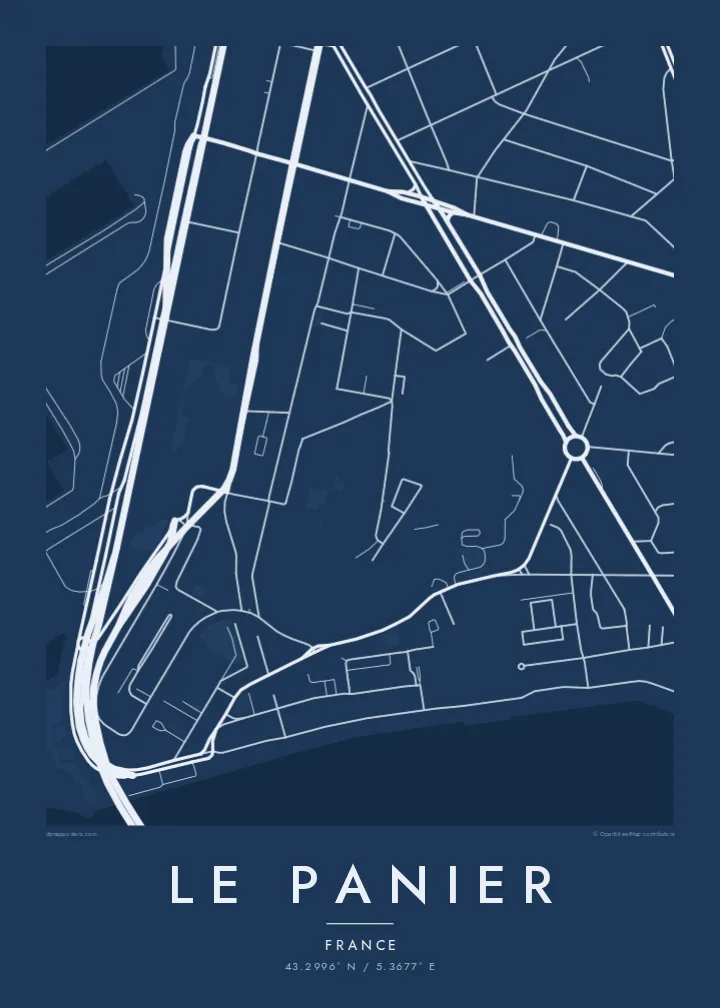
Le Panier occupies the hill on the north side of the Vieux-Port and is the oldest part of Marseille. Greek settlers from Phocaea founded Massalia here around 600 BC, and the hill has been lived on ever since. On the map, the quarter looks nothing like the straight boulevards around it. Streets bend, split and climb, often turning into stairways where the slope gets too steep.
At the center of the quarter stands the Vieille Charité, a former almshouse built in the seventeenth and eighteenth centuries around a courtyard with a domed chapel, now home to museums. To the west, the hill drops toward the sea, the Cathedral of La Major and the port. The southern edge was reshaped after parts of the old quarter by the harbor were demolished in 1943.
A Le Panier map poster shows an area of small scale and tight texture. Blocks are irregular, lanes are narrow, and the water of the Old Port gives the composition a firm, clean edge on one side. From above, the quarter looks like a dense fingerprint set against the more open plan of central Marseille, which makes it an especially graphic print.
The former almshouse forms a distinct rectangle around an open courtyard and central chapel. It is the clearest geometric shape within the irregular street pattern.
Many lanes turn into stepped passages as they climb from the port. On the map they appear as short, broken lines rather than continuous streets.
The rectangular harbor lies just to the south. Its long quays give the print a precise line of water below the dense hillside.
Fai mo oe
Faʻaopoopo se aso, se igoa po o sau lava upu, sui le sitaili, lapoʻa po o le itu.
O le preview e leai se totogi e maualalo le resolution ma iai se watermark. O lolomi ma faila HD e faia i le 300 DPI, e oo atu i le 7,200 × 10,800 px, e aunoa ma se watermark.
Aisea Le Panier
People from Marseille, former residents and travelers who climbed its lanes often remember Le Panier as the most human-scaled part of the city. Its map captures that intimacy through a crowd of small shapes.
Choose a title, add a subtitle with a date or a line in French, and edit the coordinates. Pick from five styles, with Sand giving a warm Mediterranean tone. Download the files or order a matte print.
Faatau le posita Le Panier| Lapoʻa lolomi | Manino | Faila |
|---|---|---|
| 30 × 40 cm11.8 × 15.7″ | 3,543 × 4,724 px | PNG · PDF |
| 29.7 × 42 cm (A3)11.7 × 16.5″ | 3,508 × 4,961 px | PNG · PDF |
| 42 × 59.4 cm (A2)16.5 × 23.4″ | 4,961 × 7,016 px | PNG · PDF |
| 45.7 × 61 cm18 × 24″ | 5,400 × 7,200 px | PNG · PDF |
| 50 × 70 cm19.7 × 27.6″ | 5,906 × 8,268 px | PNG · PDF |
| 61 × 91.4 cm24 × 36″ | 7,200 × 10,800 px | PNG · PDF |
Ae faʻatusatusa, o le faʻataʻitaʻiga e leai se totogi e 900 px le lautele, e iai le faʻailoga vai ma e mo mata. O faila HD e oʻo atu i le 8× le manino i itu taʻitasi ma e lolomi manino i le lapoʻa atoa o le posta.
Filifili se sitaili i le pito i luga o le itulau, ona filifili lea o le Posita Lolomi — se lapopoa ma, afai e te fiafia, se faavaa — po o Faila HD Numera. E na o le tasi laasaga o le Checkout, ma o le a fesuia'i lou itulau o oka i le taimi lava e mae'a ai le totogi.
E lolomiina i luga o pepa matte maualuga le tulaga e 200 gsm, i se tasi o lapopoa e ono, mai le 30 × 40 cm i le 24 × 36″. E amata le tau o posita lolomi mai le $39, aofia ai le auina atu.
Ioe. Filifili se faavaa laau malosi i le lanu uliuli, sina, oak masani, po o le laau pogisa. E aofia ai se tioata e le gau ma ua saunia e tautau i luga. E amata le tau o posita faavaa mai le $99, aofia ai le auina atu.
E leai se totogi o le auina atu i atunuu e 60+. O pepa ata taʻitasi e lolomiina e le tasi o matou paaga lolomi e latalata mai i atunuu e 30+, ma e masani ona taunuu i le 3–7 aso faigaluega. E mafai ona e mulimulitaia le tulaga ma le sailiga i lalo o My Orders. O nisi atunuu e 2–5 vaiaso, ma i nofoaga e lei matou auina atu iai, e taʻu atu e le saite ia te oe a o lei totogi.
Auina mai se ata i totonu o le 14 aso talu ona taunuu, ma o le a matou toe lolomiina e leai se totogi po o le toe faafoi atu lau tupe.
Ioe. I totonu o le editor i lenei itulau, suia le ulutala, le ulutala laititi ma le laina o coordinates i soo se mea e te fiafia i ai, ma filifili se sitaili ma le lapopoa. O oka lolomi, faavaa ma numera e faaaoga uma lava lau mamanu.
Mo le $9 e te maua ai faila PNG 300 DPI ma PDF ua saunia mo le lolomi i lapopoa uma e ono, e aunoa ma se watermark, e mafai ona lolomi i soo se mea. Le mautinoa lava? Download muamua se preview e leai se totogi ma le watermark.
Latalata ane
