Vieux-Port
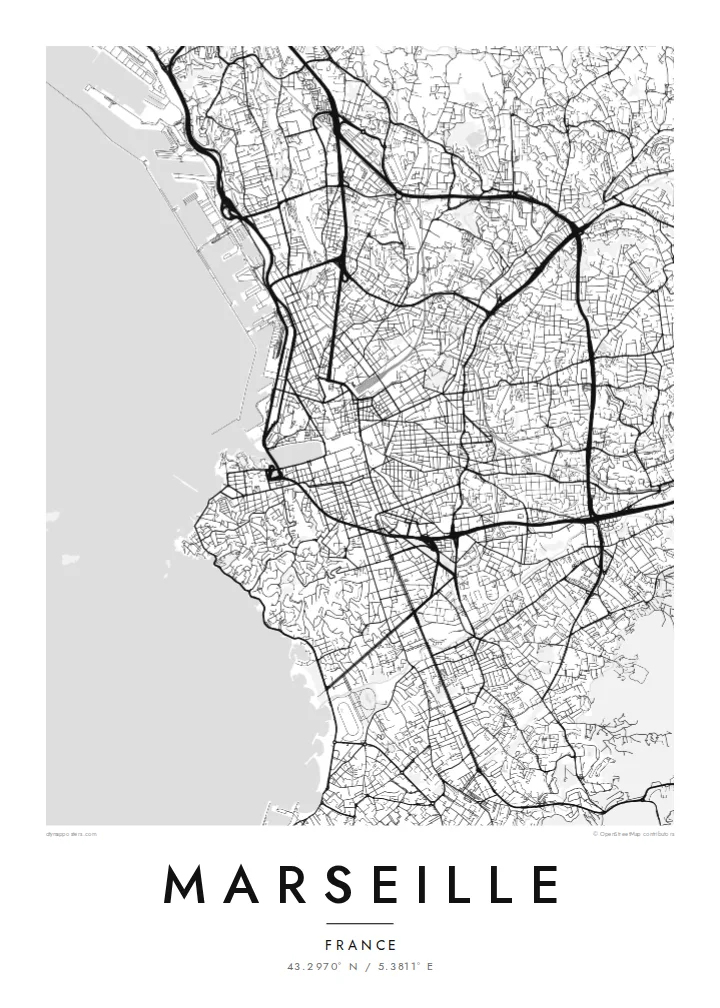
The ancient harbour forms a narrow rectangle of water reaching into the heart of the city. It is the natural centre of any composition, with streets converging on its quays.
Posta faʻafanua faigofie · France
43.2970° N / 5.3811° E
A rugged bowl of hills around a deep old harbour, open to the sea on the west and edged by limestone inlets.


Tasi le aai, lagona e lima
Tapi se sitaili e vaai ai i luga o le puipui. E tutusa uma le tau o sitaili — pe lolomiina, faapipiiina, pe avea ma faila HD.
 Pika Moni · Faila Lolomi 24 × 36″
Manino mo le lolomi
O se vaega atoa (100%) lenei mai le faila lolomi moni. O posita uma — pe lolomiina, faapipiiina pe download mai — e faia i luga o a matou server i le 300 DPI, e oo atu i le 7,200 × 10,800 pika, ina ia manino pea auala laiti i luga o se lolomiga 24 × 36″.
I luga o le puipui


Le faʻafanua
Marseille was founded around 600 BC by Greek sailors from Phocaea, who called it Massalia, and it is usually described as the oldest city in France. The original harbour, now the Vieux-Port, is a long rectangular inlet cutting deep into the city. La Canebière runs east from its head, the main axis of the centre.
The city fills a wide amphitheatre of hills that open towards the sea. On the tallest hill south of the port stands the basilica of Notre-Dame de la Garde, visible from almost everywhere. At the harbour entrance, Fort Saint-Jean and Fort Saint-Nicolas face each other, and the MuCEM museum is linked to the old fort by a footbridge.
Offshore lie the Frioul islands and the small island fortress of the Château d'If. To the north, modern port basins stretch along the coast, while to the southeast the city ends in the white limestone cliffs of the Calanques National Park. A Marseille map poster traces a coastline that changes character completely from one end to the other.
The ancient harbour forms a narrow rectangle of water reaching into the heart of the city. It is the natural centre of any composition, with streets converging on its quays.
The basilica sits on a limestone hill south of the port. Around it, the streets bend and switch back up the slope, a clear sign of the terrain in a flat drawing.
A small group of rocky islands sits just off the coast, with the Château d'If on the smallest of them. On the poster they appear as fine shapes floating in the open sea.
Fai mo oe
Faʻaopoopo se aso, se igoa po o sau lava upu, sui le sitaili, lapoʻa po o le itu.
O le preview e leai se totogi e maualalo le resolution ma iai se watermark. O lolomi ma faila HD e faia i le 300 DPI, e oo atu i le 7,200 × 10,800 px, e aunoa ma se watermark.
Aisea Marseille
Marseille inspires strong loyalty, and a map of its port, hills and coast suits both those who grew up there and those who fell for it on a visit. The harbour gives the poster a clear centre that works in any size.
Add your own title and a subtitle such as an arrondissement or a date, and adjust the coordinates line. Choose from Classic black & white, Noir, Paper, Blueprint and Sand. HD files cost $9, and printed posters come on matte paper with an optional wooden frame.
Faatau le posita Marseille| Lapoʻa lolomi | Manino | Faila |
|---|---|---|
| 30 × 40 cm11.8 × 15.7″ | 3,543 × 4,724 px | PNG · PDF |
| 29.7 × 42 cm (A3)11.7 × 16.5″ | 3,508 × 4,961 px | PNG · PDF |
| 42 × 59.4 cm (A2)16.5 × 23.4″ | 4,961 × 7,016 px | PNG · PDF |
| 45.7 × 61 cm18 × 24″ | 5,400 × 7,200 px | PNG · PDF |
| 50 × 70 cm19.7 × 27.6″ | 5,906 × 8,268 px | PNG · PDF |
| 61 × 91.4 cm24 × 36″ | 7,200 × 10,800 px | PNG · PDF |
Ae faʻatusatusa, o le faʻataʻitaʻiga e leai se totogi e 900 px le lautele, e iai le faʻailoga vai ma e mo mata. O faila HD e oʻo atu i le 8× le manino i itu taʻitasi ma e lolomi manino i le lapoʻa atoa o le posta.
Filifili se sitaili i le pito i luga o le itulau, ona filifili lea o le Posita Lolomi — se lapopoa ma, afai e te fiafia, se faavaa — po o Faila HD Numera. E na o le tasi laasaga o le Checkout, ma o le a fesuia'i lou itulau o oka i le taimi lava e mae'a ai le totogi.
E lolomiina i luga o pepa matte maualuga le tulaga e 200 gsm, i se tasi o lapopoa e ono, mai le 30 × 40 cm i le 24 × 36″. E amata le tau o posita lolomi mai le $39, aofia ai le auina atu.
Ioe. Filifili se faavaa laau malosi i le lanu uliuli, sina, oak masani, po o le laau pogisa. E aofia ai se tioata e le gau ma ua saunia e tautau i luga. E amata le tau o posita faavaa mai le $99, aofia ai le auina atu.
E leai se totogi o le auina atu i atunuu e 60+. O pepa ata taʻitasi e lolomiina e le tasi o matou paaga lolomi e latalata mai i atunuu e 30+, ma e masani ona taunuu i le 3–7 aso faigaluega. E mafai ona e mulimulitaia le tulaga ma le sailiga i lalo o My Orders. O nisi atunuu e 2–5 vaiaso, ma i nofoaga e lei matou auina atu iai, e taʻu atu e le saite ia te oe a o lei totogi.
Auina mai se ata i totonu o le 14 aso talu ona taunuu, ma o le a matou toe lolomiina e leai se totogi po o le toe faafoi atu lau tupe.
Ioe. I totonu o le editor i lenei itulau, suia le ulutala, le ulutala laititi ma le laina o coordinates i soo se mea e te fiafia i ai, ma filifili se sitaili ma le lapopoa. O oka lolomi, faavaa ma numera e faaaoga uma lava lau mamanu.
Mo le $9 e te maua ai faila PNG 300 DPI ma PDF ua saunia mo le lolomi i lapopoa uma e ono, e aunoa ma se watermark, e mafai ona lolomi i soo se mea. Le mautinoa lava? Download muamua se preview e leai se totogi ma le watermark.
Latalata ane
