Natore Rajbari grounds
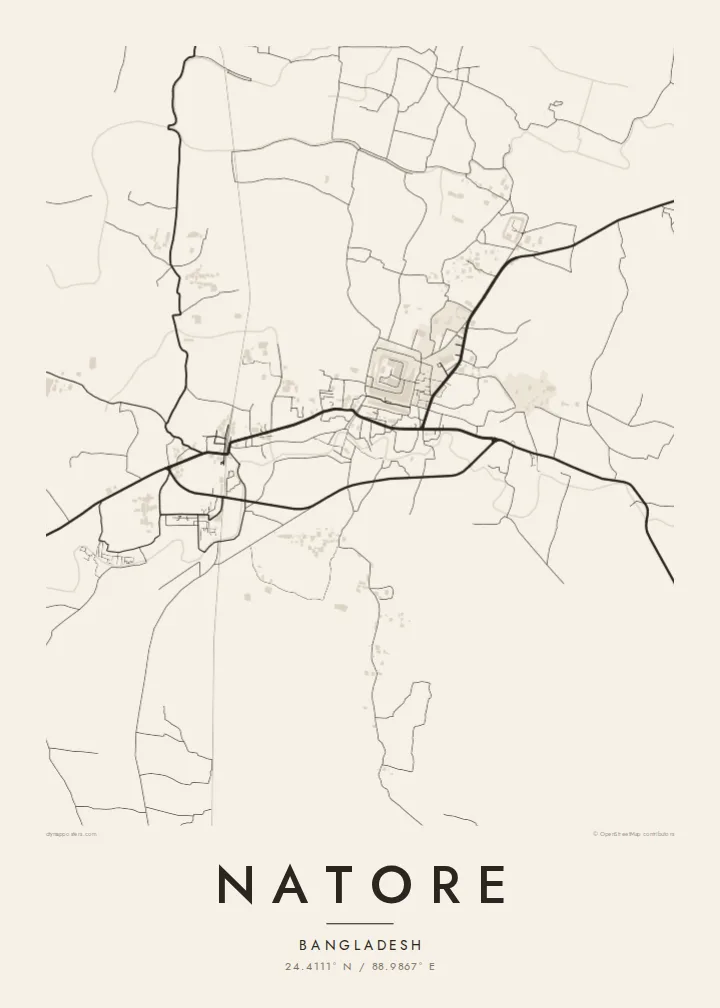
The old palace complex of the Natore Raj covers a broad, open patch on the map, its ponds and gardens standing apart from the dense, irregular streets around it.
Fakatino mape mukamuka · Bangladesh
24.4111° N / 88.9867° E
A compact district town of winding lanes, palace grounds and scattered ponds, set in flat, water-laced country near the Chalan Beel wetland.



Taha e taone, lima e onoonoaga
Tapaki e taha puhala ke kitia ai ki luga he puipui. Kua tatai e totogi he tau puhala oti — pete he lolomi, poloka, po ke faila HD.
 Tau pikselo mooli · faila lolomi 24 × 36″
Maama mitaki ke lolomi
Ko e 100% e fahi mooli mai he faila lolomi. Ko e tau poster oti — pete kua lolomi, poloka, po ke utu hifo — kua taute ke he ha mautolu a tau tokoluga (server) ke he 300 DPI, hokotia ke he 7,200 × 10,800 piksela, ke maeke ai e tau ala ikiiki tote ke maaliali fakamitaki he lolomi 24 × 36″.
He Pā


Ko e mape
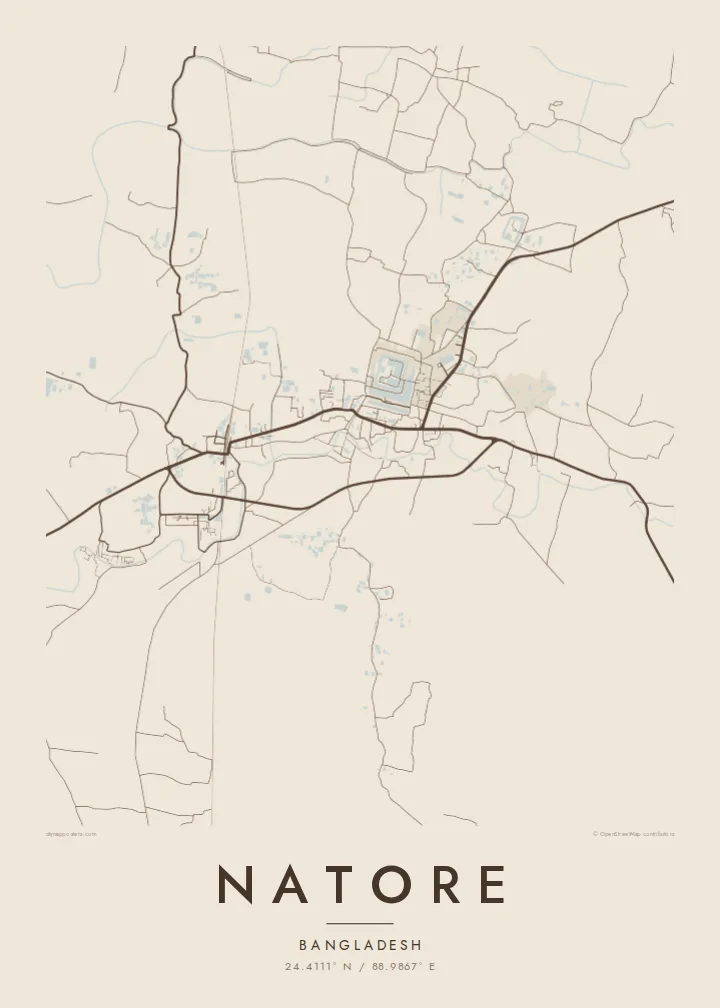
Seen from above, Natore does not follow a grid. Its streets bend and branch the way older Bengali towns grew, following paths between neighbourhoods, markets and water. Small ponds and tanks show up as quiet blank shapes between the lines, and the built-up core thins out quickly into fields. In black and white, that loose, organic pattern reads as a town shaped over centuries rather than planned.
The town is best known as the seat of the Natore Raj, the zamindar family linked with Rani Bhabani, the eighteenth-century landholder remembered for her administration and charity. The Natore Rajbari, the old palace complex, still sits within its own grounds of lawns and ponds. A Natore map poster picks these enclosures out clearly: larger, calmer blocks of space set against the finer grain of the surrounding streets.
Just north of the town lies Dighapatia Palace, now known as Uttara Gonobhaban, which serves as the government's official residence in the north of Bangladesh. Beyond the edges, the land is low and wet, part of the wider basin around Chalan Beel, one of the country's largest wetlands. For many Bengali readers the name also calls up a single line of poetry, Jibanananda Das's Banalata Sen of Natore.
The old palace complex of the Natore Raj covers a broad, open patch on the map, its ponds and gardens standing apart from the dense, irregular streets around it.
The Dighapatia palace on the town's northern side shows up as another walled estate with water features, now the official northern residence of the Bangladeshi government.
Tanks, ponds and wet fields surround the town, a reminder of the Chalan Beel basin nearby. On the poster they break the street network into softer, uneven shapes.
Taute ke ha hau
Lafi e aho, taha higoa po ke taha kupu haau, hiki e fakatino, lahi po ke tuaga.
Ko e kitiaaga nakai totogi kua tote e maaliali mo e fakamailoga vai. Ko e tau lolomi mo e tau faila HD kua taute ke he 300 DPI, hokotia ke he 7,200 × 10,800 px, nakai fai fakamailoga vai.
Ko e ha Natore
Natore means something particular to the people connected to it: a home district, a family house near the Rajbari, or the town from a poem learned at school. A map of its lanes and palace grounds lets you keep that connection on the wall without it looking like a tourist souvenir.
You can add your own title, a subtitle such as a family name or a date, and the coordinates line. The poster comes in five styles: Classic black & white, Noir, Paper, Blueprint and Sand. Buy the HD files for $9, or order a matte print with an optional wooden frame.
Talaage e poster Natore| Lahi he lolomi | Maama | Tau faila |
|---|---|---|
| 30 × 40 cm11.8 × 15.7″ | 3,543 × 4,724 px | PNG · PDF |
| 29.7 × 42 cm (A3)11.7 × 16.5″ | 3,508 × 4,961 px | PNG · PDF |
| 42 × 59.4 cm (A2)16.5 × 23.4″ | 4,961 × 7,016 px | PNG · PDF |
| 45.7 × 61 cm18 × 24″ | 5,400 × 7,200 px | PNG · PDF |
| 50 × 70 cm19.7 × 27.6″ | 5,906 × 8,268 px | PNG · PDF |
| 61 × 91.4 cm24 × 36″ | 7,200 × 10,800 px | PNG · PDF |
Ke fakatatai, ko e fakatino noa kua 900 px e laulahi, fai fakamailoga mo e mo e tau mata komipiuta ni. Ko e tau faila HD kua ato hoko ke he 8× e maama ke he tau faahi takitaha mo e lolomi mitaki he lahi katoa he fakatino.
Fifili e taha puhala i luga he kupega, ti fifili e Poster Lolomi — e lahi mo e, kaeke ke manako ai koe, taha poloka — po ke Tau Faila HD Fakaeletonika. Ko e fakaotiaga totogi ko e taha gahua ni, ti ko e kupega he hau a talaaga ka fakafou fakahaga i mua he fakaotiaga e totogi.
Kua lolomi ai ke he pepa mitaki 200 gsm matte he taha he tau lahi ono, mai he 30 × 40 cm ke hoko ke he 24 × 36″. Kamata e tau poster lolomi mai he $39, kua putoia ai e utaaga.
E. Fifili e poloka akau malolō ke he lanu uli, tea, akau oki mooli, po ke akau pouli. Kua fakalataha mo e sioga malolō nakai malepe ti kua mautali ke tautau. Kamata e tau poster poloka mai he $99, kua putoia ai e utaaga.
Nakai totogi e fakafano ke he motu 60+. Ko e fakatino taha kua lolomi he fenoga lolomi ha mautolu kua tata mo e tau motu 30+, kua hoko mai he tau aho gahua 3–7. Maeke ia koe ke kikite e tuaga mo e fakamuitua he lalo he Haku Tau Fakatonu. Ke he falu motu kua 2–5 e tau tapu, ti ka nakai fakafano a mautolu ki ai, to fakaha he api tupe ia ki mua he totogi.
Fakafano mai e taha ata ki a mautolu he loto he 14 e tau aho tali mai he hokoaga, ti to lolomi foki e mautolu nakai totogi po ke liu atu e totogi ki a koe.
E. He editor i luga he kupega nei, hikihiki e matakupu, e matakupu lalo mo e laini coordinates ke he taha mena kua manako a koe ki ai, ti fifili e puhala mo e lahi. Ko e tau talaaga lolomi, poloka mo e fakaeletonika oti kua fakaaoga tonu e hau a fakatino.
Ma e $9 ka moua e koe e tau faila PNG 300 DPI mo e PDF kua mautali ke lolomi he tau lahi ono oti, nakai fai fakamailoga vai, ke lolomi i fe mena. Nakai maopoopo agaia? Utu hifo fakamua e kitiaaga nakai totogi ne fai fakamailoga vai.
Tata mai
