The BR-316 axis
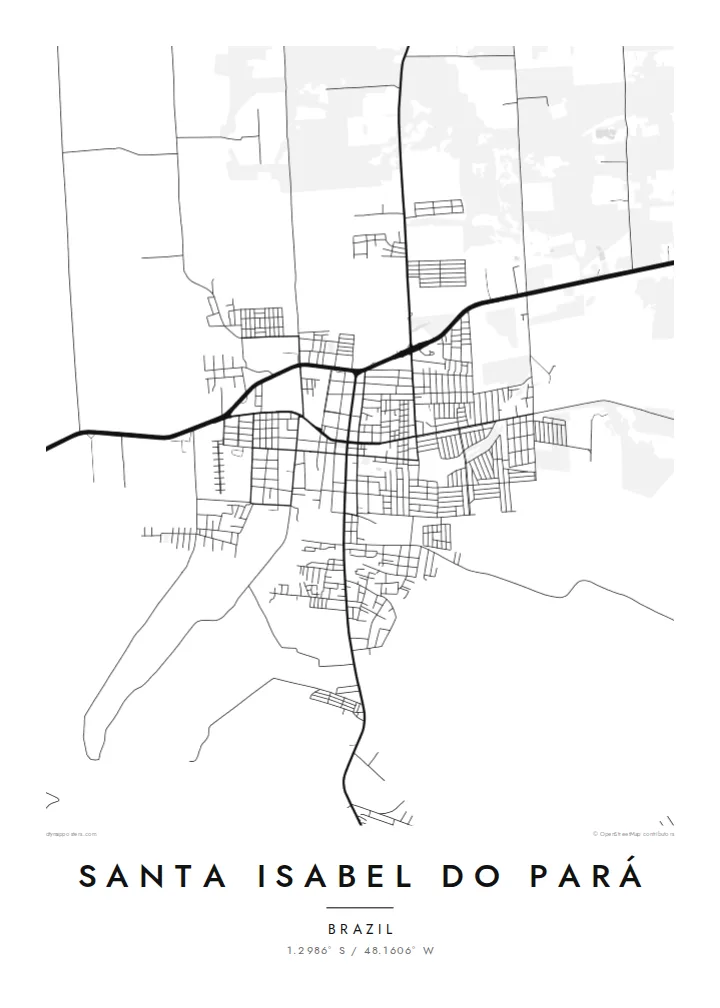
The highway draws a firm diagonal through the town. Most of the street network hangs from it like branches from a stem, which gives the poster a clear sense of direction.
Fakatino mape mukamuka · Brazil
1.2986° S / 48.1606° W
A town strung along the BR-316 east of Belém, where roadside blocks give way to creeks and dense green lowland
Taha e taone, lima e onoonoaga
Tapaki e taha puhala ke kitia ai ki luga he puipui. Kua tatai e totogi he tau puhala oti — pete he lolomi, poloka, po ke faila HD.
 Tau pikselo mooli · faila lolomi 24 × 36″
Maama mitaki ke lolomi
Ko e 100% e fahi mooli mai he faila lolomi. Ko e tau poster oti — pete kua lolomi, poloka, po ke utu hifo — kua taute ke he ha mautolu a tau tokoluga (server) ke he 300 DPI, hokotia ke he 7,200 × 10,800 piksela, ke maeke ai e tau ala ikiiki tote ke maaliali fakamitaki he lolomi 24 × 36″.
He Pā


Ko e mape
Santa Isabel do Pará lies on the eastern edge of Greater Belém, in the humid lowlands near the Amazon estuary. The BR-316, the main highway toward the northeast of the state, runs straight through it, and much of the town has grown along that road. From above this gives the place a strong central spine. Neighbourhoods branch off to either side before thinning into forest and small farms.
The land is flat and laced with streams, so many streets bend around low, wet ground instead of following a strict grid. At the margins, small waterways feeding the region's larger river systems appear as thin, winding lines. A Santa Isabel do Pará map poster captures this meeting of a road-built town and a watery landscape in one balanced frame.
Its place in the metropolitan area makes the town both a commuter base and a gateway to the interior of Pará. The rivers in the surrounding countryside are popular for weekend outings from the capital. On paper the map becomes a quiet study of growth: one clear axis, a spread of side streets, and soft, uneven edges where the town meets the Amazonian green.
The highway draws a firm diagonal through the town. Most of the street network hangs from it like branches from a stem, which gives the poster a clear sense of direction.
Narrow streams wind through the outskirts. Around them the street pattern loosens and curves, showing how the water-shaped ground has guided building.
On one side the map shows the steady spread of Greater Belém, and on the other the open green of rural Pará. The town sits exactly where the two meet.
Taute ke ha hau
Lafi e aho, taha higoa po ke taha kupu haau, hiki e fakatino, lahi po ke tuaga.
Ko e kitiaaga nakai totogi kua tote e maaliali mo e fakamailoga vai. Ko e tau lolomi mo e tau faila HD kua taute ke he 300 DPI, hokotia ke he 7,200 × 10,800 px, nakai fai fakamailoga vai.
Ko e ha Santa Isabel do Pará
The poster suits anyone who commutes along the BR-316, grew up on these streets or has family in Pará. Put the town name in the title, a date or dedication in the subtitle, and keep the coordinates line as a precise marker of home.
Noir turns the winding creeks and branching streets into bright lines on black. Paper gives them a softer, printed-page feel. For $9 the digital files cover six sizes, from 30×40 cm to 24×36″, with no watermark. A free 900 px preview lets you check the layout first.
Talaage e poster Santa Isabel do Pará| Lahi he lolomi | Maama | Tau faila |
|---|---|---|
| 30 × 40 cm11.8 × 15.7″ | 3,543 × 4,724 px | PNG · PDF |
| 29.7 × 42 cm (A3)11.7 × 16.5″ | 3,508 × 4,961 px | PNG · PDF |
| 42 × 59.4 cm (A2)16.5 × 23.4″ | 4,961 × 7,016 px | PNG · PDF |
| 45.7 × 61 cm18 × 24″ | 5,400 × 7,200 px | PNG · PDF |
| 50 × 70 cm19.7 × 27.6″ | 5,906 × 8,268 px | PNG · PDF |
| 61 × 91.4 cm24 × 36″ | 7,200 × 10,800 px | PNG · PDF |
Ke fakatatai, ko e fakatino noa kua 900 px e laulahi, fai fakamailoga mo e mo e tau mata komipiuta ni. Ko e tau faila HD kua ato hoko ke he 8× e maama ke he tau faahi takitaha mo e lolomi mitaki he lahi katoa he fakatino.
Fifili e taha puhala i luga he kupega, ti fifili e Poster Lolomi — e lahi mo e, kaeke ke manako ai koe, taha poloka — po ke Tau Faila HD Fakaeletonika. Ko e fakaotiaga totogi ko e taha gahua ni, ti ko e kupega he hau a talaaga ka fakafou fakahaga i mua he fakaotiaga e totogi.
Kua lolomi ai ke he pepa mitaki 200 gsm matte he taha he tau lahi ono, mai he 30 × 40 cm ke hoko ke he 24 × 36″. Kamata e tau poster lolomi mai he $39, kua putoia ai e utaaga.
E. Fifili e poloka akau malolō ke he lanu uli, tea, akau oki mooli, po ke akau pouli. Kua fakalataha mo e sioga malolō nakai malepe ti kua mautali ke tautau. Kamata e tau poster poloka mai he $99, kua putoia ai e utaaga.
Nakai totogi e fakafano ke he motu 60+. Ko e fakatino taha kua lolomi he fenoga lolomi ha mautolu kua tata mo e tau motu 30+, kua hoko mai he tau aho gahua 3–7. Maeke ia koe ke kikite e tuaga mo e fakamuitua he lalo he Haku Tau Fakatonu. Ke he falu motu kua 2–5 e tau tapu, ti ka nakai fakafano a mautolu ki ai, to fakaha he api tupe ia ki mua he totogi.
Fakafano mai e taha ata ki a mautolu he loto he 14 e tau aho tali mai he hokoaga, ti to lolomi foki e mautolu nakai totogi po ke liu atu e totogi ki a koe.
E. He editor i luga he kupega nei, hikihiki e matakupu, e matakupu lalo mo e laini coordinates ke he taha mena kua manako a koe ki ai, ti fifili e puhala mo e lahi. Ko e tau talaaga lolomi, poloka mo e fakaeletonika oti kua fakaaoga tonu e hau a fakatino.
Ma e $9 ka moua e koe e tau faila PNG 300 DPI mo e PDF kua mautali ke lolomi he tau lahi ono oti, nakai fai fakamailoga vai, ke lolomi i fe mena. Nakai maopoopo agaia? Utu hifo fakamua e kitiaaga nakai totogi ne fai fakamailoga vai.
Tata mai
